

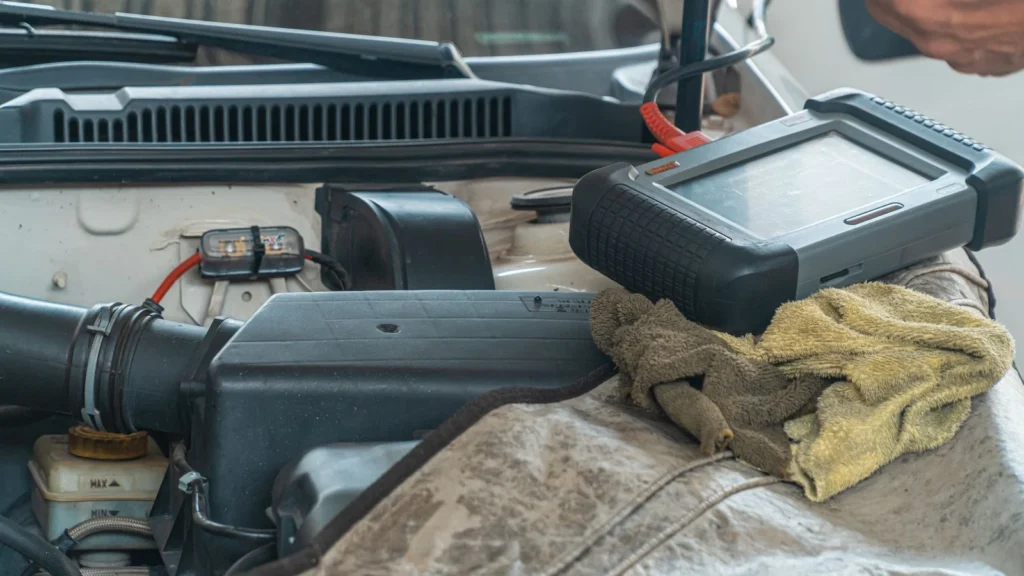
The starter uses battery power to crank the engine; the alternator replenishes the battery while the engine runs. Because weak supply, damaged cables and control faults overlap with both, testing must come before a BMW 1 Series replacement part. If you already know the work needed, book your BMW 1 Series online; if not, choose fault finding rather than guessing a repair.
Start with the exact BMW 1 Series
The BMW 1 Series is one of the UK's most numerous licensed cars, but its model name spans different generations, engines, transmissions and sometimes electrified powertrains. Useful maintenance and repair advice must therefore start with the registration and exact derivative, with particular attention to generation, driven wheels, condition-based service items and battery registration. Entering the registration lets the booking team check the derivative before parts, fluids, labour or the repair setting are confirmed. Explore the BMW 1 Series model guide for the full ownership overview.
Safe checks you can make first
- Record whether the engine cranks, clicks once, cranks slowly or starts then loses electrical power.
- Note whether the battery warning stays on after starting or appears while driving.
- Do not repeatedly jump start a vehicle with burning smells, damaged cables or a charging warning.
- Provide recent battery, belt and starter or alternator repair history.
These are observation and handbook checks, not instructions to dismantle safety-critical, fuel, pressurised, high-voltage or moving systems. When the checks point to a real concern, request BMW 1 Series starting and charging diagnosis with the evidence you recorded.
What the symptom does—and does not—tell you
A single click may involve the starter circuit but can also follow low voltage or cable resistance. A battery warning while running commonly directs attention to the charging system, drive belt or wiring. Load, voltage-drop and charging tests separate them.
Useful details to include are:
- Slow crank, click or car not starting
- Battery or charging warning
- Engine, emissions or powertrain warning
- Brake noise, vibration or warning
- Oil, service or fluid message
A fault code or symptom narrows an investigation; it does not automatically authorise a component replacement. A good diagnosis checks whether the fault is current, reproduces the concern safely and tests the relevant system.
When to stop driving
Stop in a safe place if a red warning instructs you to stop, braking or steering is impaired, the engine is overheating, oil pressure is lost, a tyre is visibly unsafe, there is smoke/fire risk or the vehicle cannot be controlled normally. Follow the handbook and arrange recovery when driving could make the situation unsafe. For non-emergency concerns, book diagnostics or the confirmed service.
An interesting fact that changes the advice
DfT/DVLA 2026 Q1 licensed-car data records 400,910 BMW 1 Series vehicles, the 15th-largest model group in that official table.
Use authoritative vehicle information
Check the manufacturer information/manual for the exact vehicle. GOV.UK says the handbook controls how often owner checks and servicing are required, while a current MOT does not guarantee the car remains roadworthy. Wider model-group ranking facts use DfT/DVLA 2026 Q1 licensing data; SMMT Motorparc is cited separately where its cleansed top-ten figures are used.
Book the right next step
Have the registration, mileage, warning text, service history and symptom timeline ready. Then book your BMW 1 Series with SSK Mechanics, or open the most relevant service route. Appointment scope and availability are confirmed after the vehicle and job are checked.
The practical answer for this BMW 1 Series topic
Describe the behaviour before naming a failed part. The most useful account states when the concern occurs, what changes it and what the vehicle does immediately before and after. Similar noises, vibrations or drivability symptoms can originate in different systems, so repeatable evidence is more valuable than a popular online diagnosis.
Replacing the battery can temporarily hide an alternator problem because the new battery arrives charged. Confirm charging performance before assuming the repair is complete.
If the charging warning remains on, the car may stop when stored energy is depleted. Reach a safe place and arrange assistance rather than planning to drive until it fails.
A step-by-step decision path
- Write a plain description of the symptom without naming a component.
- Record whether it follows engine speed, road speed, temperature, load, braking, steering or gear.
- Identify the exact derivative and collect relevant repair history.
- Avoid repeatedly provoking slip, overheating, harsh engagement or another damaging condition.
- Preserve warnings and fault information for testing.
- Book fault finding when the failed component has not been established by evidence.
This sequence preserves evidence and puts safety before convenience. It is not a dismantling guide. If a step requires access to a lifted vehicle, pressurised system, fuel system, moving component, airbag circuit or orange high-voltage component, stop and use an appropriately equipped professional. When no stop warning is present and the vehicle remains controllable, the notes you collect can make the appointment more productive.
Why the exact version changes the answer
The same model name can cover years of engineering changes. Engine family, fuel type, gearbox, driven wheels, body style, emissions equipment, software and optional systems can all alter the relevant parts and procedure. Registration data is therefore the starting point, while a VIN, engine code or transmission code may be needed for close variants. Useful identification prompts for this model include:
- Three- and five-door used models
- Petrol and diesel
- Manual and automatic
- Rear- and front-wheel-drive generations
- xDrive derivatives
- M performance versions
Do not infer a fluid, service interval, timing-drive design, tyre pressure or reset procedure from the badge alone. Verify it against exact vehicle information. This is especially important when a search result describes a different generation or a non-UK specification: a familiar model name does not guarantee identical hardware.
Build an evidence log before parts are discussed
A short evidence log is more useful than a long list of guessed components. Record the date, mileage, outside temperature, whether the vehicle was cold or fully warm, journey length, road conditions and the exact moment the concern appeared. For a warning, photograph the entire display while safely stationary. For a noise, describe whether it follows engine speed, road speed, steering angle, braking, bumps or gear selection. For a fluid concern, record the level only with the handbook procedure and note a visible leak without touching hot or moving parts.
Also record what changed immediately before the symptom: a flat battery, jump start, tyre replacement, service, repair, heavy rain, a long idle, a short-journey period or an unfamiliar fuel stop. That timing is evidence, not proof. Keep invoices, MOT advisories and prior diagnostic reports together. Do not erase codes, disconnect the battery, repeatedly reset a monitor or add a generic treatment simply to see whether the concern disappears. Removing evidence can make an intermittent fault harder to reproduce.
What a competent assessment should separate
Fault diagnosis should separate the customer symptom from the technical cause. It may combine a controlled road test, visual inspection, scan data, measurements and component tests. The order matters: replacing parts before the symptom is confirmed can introduce new variables and leave the original fault unresolved.
Diagnosis should move from confirmation to testing. First confirm the exact complaint and vehicle. Next check basic condition, relevant service history and technical information. Then retrieve fault information where appropriate, examine live or measured data, inspect the affected system and test the most plausible causes. A code description is not a failed-part verdict: the component named in a code may be reporting a condition caused elsewhere.
The final recommendation should explain what was observed, what was tested, what remains uncertain and why the proposed work follows from the evidence. If further strip-down or workshop equipment is needed, that boundary should be stated before additional work is authorised.
Common shortcuts that create expensive mistakes
One mistake is buying the component most frequently mentioned in a forum thread without matching the year, engine and test results. Another is treating a temporary reset as a repair. A warning that disappears after a restart can still leave useful stored information. A third is combining unrelated maintenance: an MOT pass, recent oil change or new battery does not prove every vehicle system is healthy.
Avoid universal fluids, additives and reset instructions. Do not top up beyond the handbook limit, force a regeneration, provoke clutch slip, repeatedly drive through a gearbox fault or continue with a red oil-pressure, coolant, brake or steering warning. On hybrid and electric derivatives, never touch orange cables or high-voltage enclosures. Do not work beneath any vehicle unless it is supported by appropriate equipment in a controlled setting.
What affects the scope and price
A meaningful quote depends on the exact derivative, confirmed job, diagnostic time, labour access, parts specification, consumables, location and whether the work is safe to complete mobile. Two cars with the same badge can need different parts or labour because the engine, gearbox, brake package or driven wheels differ. A diagnostic appointment may establish the repair but should not pretend the final component cost is known before testing.
Compare quotes on a like-for-like basis: check whether diagnostic work, parts, fluids, disposal, travel, collection, calibration and follow-up checks are included. The cheapest headline is not comparable if the scope is different. SSK shows the applicable route after the registration and requested work are entered; additional work should be explained and authorised before it proceeds.
Mobile appointment or workshop route?
Observation, many diagnostic checks, routine servicing and suitable component replacements may be possible at a home or workplace with firm, level, legal parking and adequate working space. Work needing a lift, controlled fluid handling, heavy removal, alignment, calibration, high-voltage isolation or extended road testing may require a workshop or collection route. Weather, access, parking restrictions and the vehicle’s ability to move safely also affect the decision.
Tell the booking team if the car is in a multi-storey car park, on a busy road, blocked in, unable to select neutral, leaking heavily or displaying a stop warning. These details are operational and safety information, not inconveniences to leave until arrival. If the route is uncertain, start the booking with the exact vehicle and symptoms so it can be reviewed.
Questions to answer before the appointment
- What is the registration, mileage, model year, engine or powertrain and gearbox?
- What exactly happens, when did it begin and can it be reproduced without creating danger?
- Which warnings appear, what colour are they and what precise wording is shown?
- What recent work, battery event, impact, tyre change or service preceded the concern?
- Is the vehicle safe and legal to move, and is the parking place suitable for mobile work?
- Which invoices, MOT advisories, photographs or prior fault reports can be provided?
Clear answers reduce ambiguity. They do not replace inspection, but they help select the right booking category, allocate realistic time and avoid arriving with assumptions based only on a model badge. When ready, open the relevant BMW 1 Series starting and charging diagnosis route.
Simple care habits and pre-checks
Small, repeatable checks are more useful than occasional guesswork. Before a longer journey, walk around the car while it is safely parked. Look for an obviously low or damaged tyre, a fresh patch beneath the vehicle, loose trim, damaged lamps or anything obstructing a camera or sensor. Test exterior lights with help or a reflection, check washer operation, and keep the windscreen clear. Use the vehicle label and handbook for tyre pressures, then consider a tyre or wheel-related inspection if pressure repeatedly falls or damage is visible.
Check fluid levels only at the time, temperature and surface conditions stated in the handbook. Never remove a coolant cap when hot, reach near belts or fans, or substitute a generic fluid. A level that repeatedly drops needs investigation rather than repeated topping-up. Keep the battery area clean and secure without touching damaged cables; slow cranking, dimming or repeated flat-battery events are reasons to consider battery and charging checks.
Listen for changes during normal driving without deliberately provoking them. New brake noise, pulling, vibration or reduced performance should lead to a brake assessment, while a planned maintenance reminder belongs with registration-specific servicing. These links are next steps, not a diagnosis: if the vehicle is unsafe, stop and arrange appropriate assistance.
External sources worth keeping
Use primary sources instead of copying an unsourced answer. Keep the manufacturer manual linked above for model-specific controls and warnings. Use GOV.UK roadworthiness guidance for driver responsibilities and legal tyre information, and the official GOV.UK MOT history service for test dates, results and advisories. The wider ranking comes from DfT/DVLA 2026 Q1 licensed-car data; SMMT Motorparc separately supports facts attributed to its published top ten. A source supports the fact it publishes; it does not diagnose the car in front of you.
Review the result, not just the replaced part
After work, retain the invoice and note the mileage, parts or fluids used, tests completed and any follow-up advice. Confirm that the original symptom was rechecked under appropriate conditions. Some monitors need a defined drive cycle or time before readiness is restored; that does not justify clearing evidence immediately before an MOT. If the symptom returns, record whether it is identical or different and contact the repairer with the new evidence.
Planned maintenance should be recorded separately from fault repair. A service can identify concerns but is not automatically a diagnosis of every warning, and replacing one failed part does not reset unrelated maintenance requirements.
Frequently asked questions
Can one service interval apply to every BMW 1 Series?
No. The model name can span different years, engines, powertrains and service regimes. Use the handbook/service information for the exact registration.
Does a warning light identify the failed BMW 1 Series part?
No. It identifies a system or condition detected by the vehicle. Fault information, symptoms, testing and inspection are needed before a repair is authorised.
Can I book BMW 1 Series starting and charging diagnosis online?
Yes. Enter the registration and requested work on the SSK booking page. The team confirms vehicle fit, scope, setting and availability.