

Electric vehicles are exempt from plenty of things that apply to petrol and diesel cars, which leads a fair number of new EV owners to wonder whether the MOT applies to them at all. The short answer is yes, it does, though the test looks slightly different for an electric car than it does for a combustion-engined one, and understanding exactly what changes helps you prepare properly rather than assuming the process is either identical or entirely different.
The basic rule: yes, EVs need an MOT
Like any other car, a fully electric vehicle needs its first MOT once it reaches three years old, and then annually after that, following exactly the same timing rules that apply to petrol and diesel cars. There’s no exemption based on fuel type when it comes to the requirement itself, only in terms of which specific checks apply once the car is at the test centre.
What’s different about testing an EV
The most obvious difference is the emissions portion of the test, which simply doesn’t apply to a fully electric car since there’s no exhaust and no tailpipe emissions to measure. This removes one of the more common fail categories entirely for EV owners, along with anything related to the exhaust system itself, since there isn’t one. Everything else on the standard checklist still applies: lights, tyres, brakes, steering and suspension, seatbelts, the horn, wipers and washers, structure and bodywork, mirrors, and the registration plate and VIN.
Testers also check items specific to electric vehicles, including the condition of the charging port and cable if applicable, and general checks around the high-voltage system’s visible components, though the internal condition and health of the traction battery itself sits outside the scope of the MOT.
Why brakes often show different wear patterns
Most EVs use regenerative braking, which recovers energy under deceleration and reduces reliance on the traditional friction brakes for everyday slowing down. This often means EV brake pads and discs last considerably longer than on an equivalent petrol or diesel car, since the friction brakes are doing less of the day to day work. Testers are trained to account for this when assessing brake condition, since a lightly worn set of pads on an EV isn’t necessarily a sign of neglect the way it might suggest on a conventional car, but the braking system as a whole, including the mechanical components, is still fully tested to the same safety standard.
Why tyres deserve particular attention on an EV
Electric vehicles tend to be heavier than equivalent petrol or diesel models due to the weight of the battery pack, and they also deliver instant torque from a standstill, both of which can accelerate tyre wear compared with a conventional car. This makes tyre checks especially relevant for EV owners, since it’s genuinely common for EV tyres to need replacing sooner than an owner used to a petrol car might expect, and a worn tyre remains just as much of an MOT fail point on an electric car as on any other vehicle.
- Check tyre tread regularly, since EV weight and torque often accelerate wear
- Every external light is still fully tested, same as any other car
- The charging port and cable condition may be checked if fitted permanently to the vehicle
- Structure and bodywork checks apply identically, including corrosion assessment
- The high-voltage traction battery is not part of the standard MOT checklist
What’s not covered, and why a separate battery health check matters
The MOT doesn’t assess the health or remaining capacity of an EV’s traction battery, which is arguably the single most important and most expensive component on the car. Battery degradation happens gradually over time and with charging habits, and a car can pass its MOT with a battery that’s lost a meaningful amount of its original range capacity, since that simply isn’t something the test measures. For EV owners genuinely wanting to understand the health of their car’s most valuable component, a separate specialist battery health check is worth considering, particularly ahead of selling the car or if you’ve noticed a real-world drop in range compared with when it was new.
Hybrid vehicles and how they differ again
Hybrid vehicles with a combustion engine alongside an electric motor still go through the emissions portion of the test on the petrol or diesel side, since they do have an exhaust system, though the way this is measured can differ slightly depending on how the specific hybrid system manages engine operation during the test itself. Plug-in hybrids and standard hybrids are both treated broadly the same way as a conventional car for testing purposes, with the added consideration of checking the health of the smaller hybrid battery pack, which similarly sits outside the standard MOT checklist despite being a genuinely important component to keep an eye on.
Cost considerations for EV owners
Without an exhaust system or the associated wear items like a catalytic converter or DPF, EV owners generally have fewer expensive MOT-related repair categories to worry about compared with combustion-engined cars. That said, tyres and brakes still need attention, and while brake wear is often reduced thanks to regenerative braking, tyre costs can end up being a larger recurring expense than some new EV owners initially expect, given the faster wear rates and, in some cases, the specific EV-rated tyres some manufacturers recommend.
Understanding battery degradation, even though the MOT doesn’t test it
Every EV battery gradually loses a small amount of its original capacity over time, influenced by factors including charging habits, exposure to extreme temperatures, and overall mileage. This degradation happens slowly and is generally not something most owners notice dramatically from one year to the next, but it does mean the real-world range of an older EV is typically somewhat lower than when the car was new. Because the MOT doesn’t assess this at all, an EV owner genuinely interested in tracking their battery’s health needs to seek that information separately, whether through the car’s own onboard diagnostics, a specialist health check, or in some cases a manufacturer app that displays a rough state-of-health figure.
This matters most at two points: when buying a used EV, where battery health is arguably more important to the car’s overall value than mileage alone, and when deciding whether to keep an ageing EV for a further few years or move on to something newer. Neither decision is well served by relying on MOT history, since a clean MOT record tells you nothing meaningful about how much usable range the battery still has left.
Servicing needs for EVs compared with combustion cars
Electric vehicles generally have fewer wearing mechanical parts than petrol or diesel cars, since there’s no engine oil to change, no timing belt, and no exhaust system to maintain. This often leads to lower overall servicing costs and simpler maintenance schedules, though it doesn’t mean an EV needs no attention at all. Brake fluid still needs periodic replacement, cabin filters still need changing, and the cooling system for the battery and electric motor still needs checking, alongside the tyres and brakes covered elsewhere in this guide. Treating an EV as entirely maintenance-free is a common misconception that can lead to smaller issues being missed simply because the owner assumes there’s nothing to check.
Preparing your EV for its MOT
Much of the standard pre-MOT preparation still applies directly: checking every light works, checking tyre tread and condition carefully given the faster wear typical on EVs, checking the windscreen for chips, and confirming wipers and washers work properly. Because the emissions and exhaust categories are removed entirely, EV owners genuinely have one less thing to worry about compared with petrol and diesel drivers, though it’s still worth a proper pre-MOT check covering everything else, along with a separate battery health check if you want a fuller picture of the car’s overall condition beyond what the legal minimum test actually covers.
Why West Yorkshire’s EV owners should factor in local driving conditions
Bradford’s hillier routes and the wider West Yorkshire terrain place particular demands on an EV, since climbing gradients draws more from the battery and regenerative braking works differently on steep descents compared with flatter driving. This doesn’t affect MOT outcomes directly, but it’s worth being aware of when thinking about tyre wear, brake condition, and realistic range expectations, all of which can differ noticeably from the manufacturer’s advertised figures on flatter, more consistent terrain. Local EV owners often find real-world range and component wear rates are somewhat different from what a car achieves in ideal, flat-road testing conditions, which is useful context when planning for maintenance and eventual tyre or brake replacement.
How testers handle regenerative braking on the rolling road
The standard MOT brake test uses a roller machine that measures how much force each wheel’s brakes can generate, but regenerative braking on many EVs and hybrids can interfere with a reading taken this way, since the electric motor itself resists the rollers turning the wheel rather than the friction brakes doing all the work. Testers are trained to recognise vehicles where this applies and, where the roller test can’t give a reliable reading, use a road test instead, assessing brake performance during an actual drive rather than on the machine. This is a specific accommodation built into the test precisely because EV braking systems don’t always behave the way a conventional car’s does on a static roller.
The pedestrian warning system and other EV-specific checks
Because electric motors are near silent at low speed, EVs and hybrids are required to have an acoustic vehicle alerting system, sometimes called AVAS, that emits an audible sound at low speeds to warn pedestrians and cyclists who might not otherwise hear the car approaching. This system is checked as part of the MOT on vehicles fitted with one, and a fault here is treated as a genuine safety item rather than a cosmetic annoyance, given the entire point of the system is protecting people who rely on hearing traffic to judge when it’s safe to cross. Testers also give the underside of the battery pack casing a visual check where accessible, looking for damage from impacts or corrosion that could compromise the sealed enclosure protecting the high-voltage components, though this sits alongside rather than replaces the structure and bodywork checks that apply to any car.
Don’t forget the 12V battery
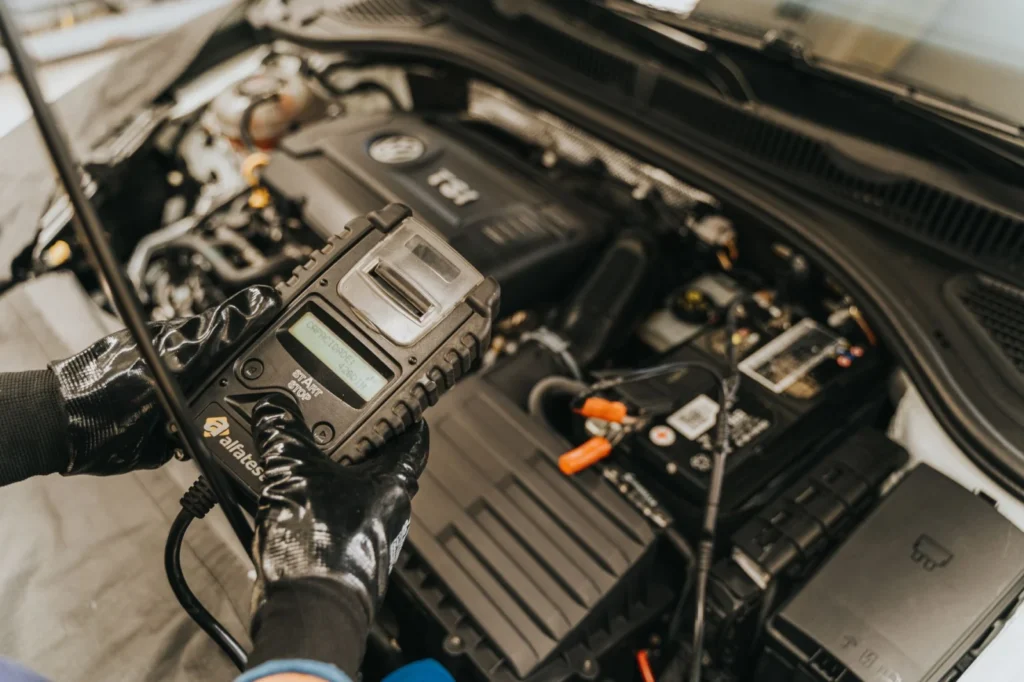
Every EV still carries a conventional 12V battery separate from the main traction pack, responsible for powering lights, indicators, the infotainment system and other low-voltage electronics. This smaller battery degrades and eventually needs replacing just like on any petrol or diesel car, and a weak 12V battery can cause exactly the kind of electrical faults, dim or flickering lights, a car that won’t wake from sleep mode properly, that show up as MOT problems having nothing to do with the main battery pack at all. It’s easy to assume an EV’s electrical system is somehow immune to this because the traction battery is so much larger, but the 12V battery is a genuinely separate, conventional component with its own limited lifespan.
Getting the most out of EV ownership between MOTs
Because the MOT doesn’t cover the areas that matter most for long-term EV ownership, namely battery health and charging system condition, it’s worth building a habit of periodically checking your own car’s reported range against what you remember from when it was newer, and getting a proper specialist look at the battery if you notice a real drop that feels more significant than gradual, expected degradation. Pairing this with the standard mechanical checks that do fall under the MOT, tyres and brakes in particular given the faster wear patterns typical on electric vehicles, gives you a genuinely complete picture of your EV’s condition rather than relying on the MOT certificate alone to tell the whole story. You can find the full official MOT requirements, which apply equally to electric vehicles alongside every other fuel type, on gov.uk’s official MOT guidance. A quick glance at the onboard trip computer or manufacturer app for a rough state-of-health estimate takes a couple of minutes and is worth doing every few months, even though it is no substitute for a proper specialist check.
Source: gov.uk's official MOT guidance
Frequently asked questions
Does a fully electric car need an MOT?
Yes, once it reaches three years old, an electric car needs an annual MOT just like a petrol or diesel car, though the emissions portion of the test does not apply.
Is the EV's battery checked during the MOT?
No, the high-voltage traction battery itself is not part of the standard MOT checklist, though the general electrical system and any visible faults may still be noted.
Are brakes tested differently on an EV?
The braking system is still tested, though regenerative braking systems mean EVs often show less wear on friction brakes, which testers are trained to account for.
Does tyre wear differ on electric cars?
EVs are generally heavier and produce more instant torque than equivalent petrol cars, which can lead to faster tyre wear, making tyre checks particularly relevant for EV owners.
Is an EV cheaper to keep roadworthy than a petrol car?
Often yes, since there is no exhaust or emissions system to maintain, though tyres and brakes still need attention and the battery itself requires separate specialist health checks.