

The real question isn’t skill, it’s risk
Plenty of car owners are perfectly capable of following a video tutorial and swapping a part correctly. The question that actually matters isn’t whether you’re capable of doing a job, it’s what happens if something goes slightly wrong. Change a bulb badly and the worst outcome is you try again. Get something wrong with a brake line or a suspension component and the consequences can be serious, for you and for anyone else on the road with you.
That’s the lens worth using when deciding which jobs are safe to DIY: not “can I physically do this” but “what’s the downside if this goes wrong, and would I know if it had?” Some faults are obvious immediately. Others, particularly with braking, steering and safety-critical electrics, might not show up until you’re relying on the part working correctly at speed.
This guide splits common car jobs into genuinely safe DIY territory, jobs that are fine for a confident and careful owner, and jobs that are best left to a garage or mobile mechanic, and explains the reasoning behind each category rather than just handing you a list.
Safe DIY: checks and consumables
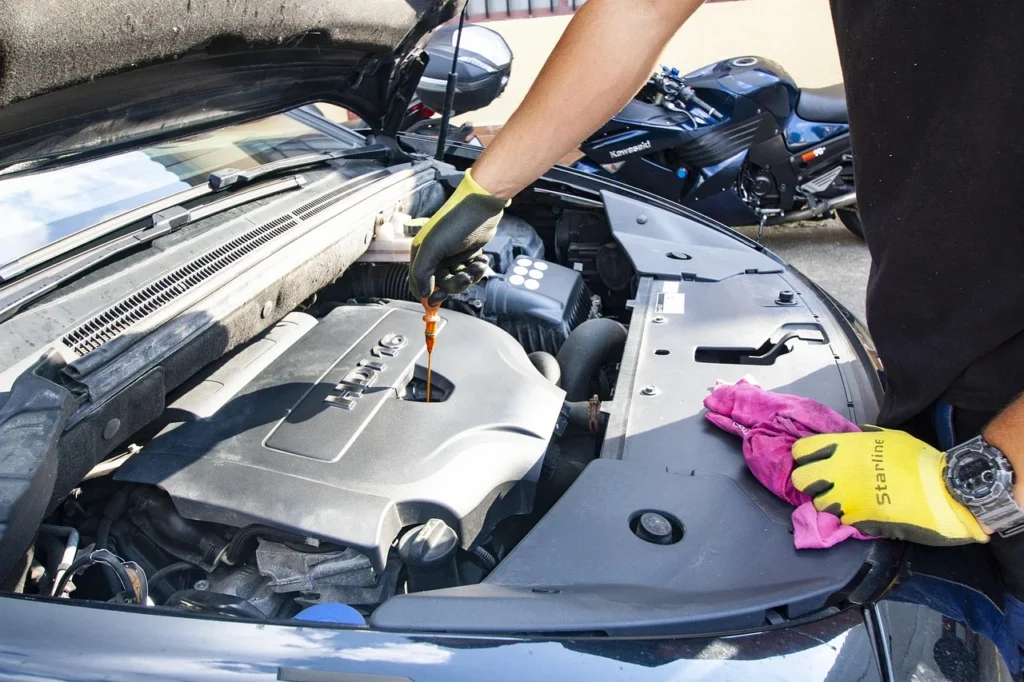
Checking and topping up fluids, oil, coolant, screen wash, power steering fluid where accessible, is genuinely safe DIY territory for almost anyone. These are designed to be owner-serviceable, with clear markings and simple procedures, and getting it slightly wrong (overfilling oil, for instance) is inconvenient rather than dangerous, and easily corrected.
Changing wiper blades, checking and adjusting tyre pressure, and replacing exterior bulbs also sit firmly in safe territory. These jobs use tools most people already own or can buy cheaply, don’t involve the car’s structural or safety-critical systems, and any mistake is immediately obvious rather than hidden until it matters. If a bulb doesn’t work after you’ve changed it, you’ll know straight away, rather than finding out on the motorway.
Checking tyre tread depth and general condition, air filter replacement on many cars, and battery terminal cleaning also fall into this category. None of these involve disturbing a system where a mistake could fail silently and cause a problem later.
Reasonably safe DIY for a confident owner
A step up from basic checks, jobs like battery replacement, cabin air filter changes, and topping up or bleeding a small amount of power steering fluid are reasonable for a confident DIYer with the right tools and a bit of research beforehand. These involve slightly more procedure than the basics, but the consequences of a mistake are still generally limited and noticeable rather than hidden.
Jump starting a car safely, when done correctly with the right lead order and precautions, is also reasonable DIY territory, though it’s worth learning the proper sequence rather than guessing, since connecting jump leads incorrectly can cause sparks or damage electronics. Windscreen washer jet adjustment and interior bulb replacement fit here too.
The common thread across this middle tier is that a mistake is either immediately obvious (the car won’t start, a fluid leaks visibly) or limited to inconvenience rather than a genuine safety risk while driving. If you’re not confident with any of these, there’s no harm in booking a mobile mechanic instead, but they’re generally within reach for someone willing to follow proper instructions carefully.
Jobs that really aren’t safe to DIY
Brake work sits at the top of this list, and for good reason. Brakes are the single system you rely on most directly for safety, and a mistake, a caliper not seated correctly, air left in the brake lines, pads fitted the wrong way round, might not be obvious until you’re braking hard and the pedal doesn’t respond the way it should. Getting brakes wrong isn’t like getting a bulb wrong, the consequences show up exactly when you need the system to work.
Suspension and steering component work, ball joints, track rod ends, wheel bearings, falls into the same category. These affect how the car handles and stops, and a poorly fitted component can fail suddenly rather than gradually, sometimes at speed. Timing belt or chain replacement is another one, since getting the timing even slightly wrong can cause catastrophic engine damage the moment the engine is started, not a gradual problem you’d notice and fix in time.
Anything involving jacking the car up without proper axle stands is unsafe regardless of the actual repair being attempted, since a jack alone can fail or slip, and a car falling on someone working underneath it is a genuinely life-threatening outcome. EV and hybrid high-voltage systems deserve their own category of caution entirely, since these carry electrical risks that aren’t present on a conventional petrol or diesel car.
Why “it looks simple online” is misleading
Online tutorials make almost every job look simple, because they show a straightforward, successful attempt with everything going right, filmed by someone experienced. What they rarely show is what happens when a bolt is seized, a part doesn’t quite fit, or a step is skipped by accident because it wasn’t obvious it mattered. The gap between “watched a video” and “can safely do this on my own car in a driveway” is bigger than it looks.
This matters especially for jobs where a mistake isn’t immediately visible. A brake job done slightly wrong might feel fine for the first few stops and only show a problem under hard braking, by which point you’re relying on a system that isn’t working as it should. Compare that to a wiper blade fitted incorrectly, which you’ll notice the very next time it rains, with essentially no safety consequence in the meantime.
If you’re weighing up whether to attempt a job, ask specifically whether a mistake would be obvious immediately or could stay hidden until the part is actually needed under pressure. That single question filters out most of the genuinely risky DIY jobs on its own.
Tools and torque: the parts that trip people up
Even straightforward-sounding jobs can go wrong without the right tools. Wheel nuts, for instance, need to be tightened to a specific torque spec, not just “as tight as you can get it,” and both over and under-tightening cause real problems, warped brake discs from overtightening, or a wheel working loose from undertightening. Without a torque wrench, it’s genuinely difficult to get this right by feel alone, however experienced you are.
Similarly, many jobs assume you have specific tools, a proper trolley jack and axle stands rather than the emergency jack that comes with the car, the correct size sockets, sometimes specialist pullers or clamps for specific components. Attempting a job with the wrong or inadequate tools is a common way an otherwise reasonable DIY job turns into a dangerous one, since the tool itself can slip or fail under load.
Before attempting any job beyond the basics, it’s worth honestly checking whether you actually have the right tools for the job, not just tools that could technically work if you’re careful, and factoring the cost of proper tools into whether DIY genuinely saves money compared with having a mechanic do it with equipment they already own.
When a “simple” fix hides a bigger problem
Some symptoms that look like a simple fix are actually surface signs of something more serious underneath. A squeaking noise might be a simple fix, or it might be an early sign of a wearing component that needs proper inspection to catch before it fails. Replacing a part that’s symptomatic without understanding the underlying cause can mean the same problem returns, sometimes worse, a short time later.
This is particularly relevant for anything involving warning lights. A dashboard light might have an obvious cause, or it might be triggered by something that needs proper diagnostic equipment to identify correctly rather than guesswork. Clearing a warning light without understanding why it appeared doesn’t fix the underlying issue, it just hides it until it triggers again, possibly at a worse moment.
If you’re not sure whether a symptom is a simple fix or a sign of something bigger, that uncertainty itself is a reasonable signal to get a proper diagnostic check rather than guessing and hoping for the best.
The cost comparison people often get wrong
DIY is often assumed to be cheaper, and for the safe, simple jobs it usually is, a bulb or wiper blade costs a fraction of what a garage would charge for the same swap. But for the riskier jobs, the calculation changes considerably once you factor in the cost of tools you might only use once, the time spent researching and attempting the job, and crucially, the cost of getting it wrong, whether that’s a failed part needing proper replacement anyway, or in the worst case, an accident caused by a faulty repair.
For safety-critical work specifically, the real comparison isn’t DIY cost versus garage cost, it’s DIY cost versus the cost and risk of a mistake that isn’t caught until it matters. A mobile mechanic visit for brake work, for instance, typically costs a fraction of what dealing with the consequences of a botched DIY brake job would cost, in both money and risk.
Being honest about this trade-off, rather than assuming DIY is automatically the cheaper option, leads to better decisions about which jobs are actually worth attempting yourself.
How to decide, job by job
A useful rule of thumb: if a mistake would be immediately obvious and limited to inconvenience, it’s likely safe DIY territory. If a mistake could be hidden until the part is genuinely needed, particularly under braking, steering or high speed, it belongs with a professional. If the job involves the car’s structure being unsupported (jacking without proper stands), high voltage systems, or precise torque and timing specifications, it’s not a reasonable DIY attempt regardless of confidence level.
It’s also worth being honest about your own experience level rather than your general confidence. Someone who’s mechanically minded in other areas, electronics, DIY around the house, isn’t automatically equipped to judge car-specific risks correctly, since the failure modes are quite different and often less forgiving.
When in doubt, the safest approach is simply to ask. A mobile mechanic can usually tell you quickly whether a job you’re considering is genuinely reasonable to attempt yourself or better left to someone with the right tools and training.
Getting professional help without the hassle of a garage
For the jobs that fall into the “leave it to a professional” category, a mobile mechanic service removes a lot of the usual friction of getting proper help, no need to book time off work, drive to a garage, and wait around. SSK Mechanics comes to your home or workplace across West Yorkshire and Bradford, covering exactly the kind of safety-critical work, brakes, suspension, diagnostics, that genuinely shouldn’t be a DIY job for most drivers.
If you’re not sure which category a job you’re considering falls into, get in touch and ask before you start. It costs nothing to check, and it can save you from a mistake that’s expensive, dangerous, or both. Book a check with SSK Mechanics and get an honest answer about whether your planned job is safe DIY territory or genuinely needs a professional.
Building confidence gradually rather than jumping in
If you’re keen to take on more of your own car maintenance, the sensible approach is to start with the genuinely safe jobs and build confidence and familiarity with your specific car before considering anything more involved. Doing your own fluid checks and bulb changes for a while teaches you how your car is put together and gives you a feel for what’s normal, which is useful groundwork even if you never move on to more complex jobs.
It’s also worth asking a mobile mechanic to talk you through a job while they’re doing it, if you’re curious, rather than attempting something unfamiliar alone the first time. Watching a professional handle a job on your own car gives you a much clearer sense of what’s actually involved than a generic online video, and helps you judge honestly whether it’s something you’d be comfortable attempting yourself in future.