

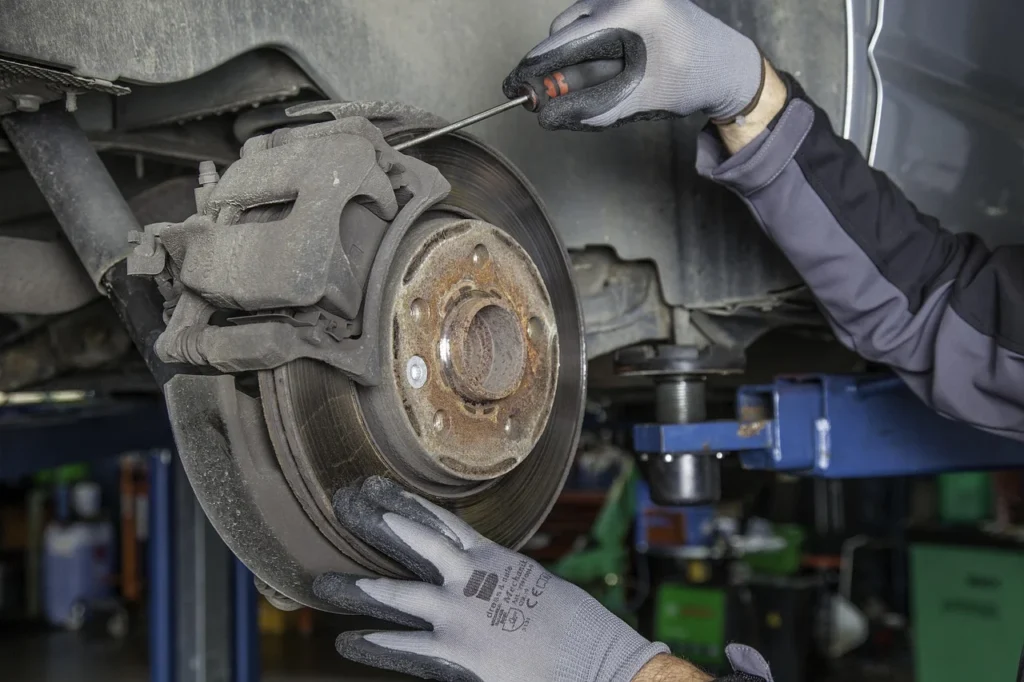
Brake pads and discs sound like a straightforward job, and mechanically they often are, but the range of quotes you’ll see for what looks like the same repair can be surprisingly wide. The reason almost always comes down to one decision: genuine or OEM parts versus aftermarket, and where on the aftermarket spectrum that particular quote sits. Brakes are also one of the few systems on a car where cutting corners on quality has a direct, measurable safety impact, which makes this a repair worth understanding properly rather than just chasing the cheapest number.
What Actually Wears: Pads vs Discs
Brake pads are the friction material that clamps against the disc every time you brake, and they’re designed as a wear item, gradually thinning with use until they need replacing. Discs (rotors) last considerably longer under normal conditions, but they do wear too, both from the friction of braking and from general corrosion, particularly if a car sits unused for periods. It’s common practice to replace discs alongside pads when the discs are close to their minimum thickness, showing significant scoring, or have developed a ridge at the outer edge where the pad hasn’t been making contact across the full surface.
Replacing pads on their own when the discs are still within specification and in good condition is perfectly reasonable and saves unnecessary cost. Replacing pads against badly worn or scored discs, on the other hand, reduces the effectiveness of new pads and can cause them to wear unevenly, which is a false economy that tends to mean paying for the discs anyway sooner than you’d have needed to.
Genuine, OEM, and Aftermarket Brake Parts
Genuine brake parts, sourced through the manufacturer’s own dealer network, are made or approved to the exact specification the car was designed around, and typically carry the manufacturer’s own warranty. OEM parts come from the same suppliers who make parts for the manufacturer in the first place, just sold independently without the manufacturer’s badge, usually at a lower price point with very little difference in quality or performance.
Aftermarket brake parts cover the widest range of any category discussed here, from well-regarded brands that independent testing consistently rates highly, to budget parts that cut corners on the friction material or metal composition in ways that affect braking performance, noise, dust, and longevity. This matters more with brakes than with almost any other component, because the difference between a good pad and a poor one shows up directly in stopping distance, particularly under hard or repeated braking, and in how the brakes perform when wet or cold. Which? has tested brake parts directly and found genuine performance differences between brands, worth reading if you want independent data behind this rather than just taking a supplier’s word for it.
This doesn’t mean genuine or OEM is automatically the only sensible choice for every car. A well-reviewed aftermarket brand can offer excellent performance at a lower price point, and for a lot of everyday driving that’s a completely reasonable choice. The point is that “aftermarket” isn’t one single tier, it spans a huge quality range, and it’s worth asking a mechanic specifically what brand and grade of part they’re quoting for rather than assuming all aftermarket options are equivalent. Pad compound is another variable worth knowing about. Standard organic or semi-metallic pads suit the vast majority of everyday driving. Performance-oriented pad compounds exist for cars driven harder or used for towing, but they can come with trade-offs like more brake dust, more noise, or reduced bite when cold, which isn’t ideal for a car doing ordinary daily journeys. A mechanic quoting your brakes should be matching the pad compound to how you actually use the car, not just fitting whatever’s on the shelf.
What Affects Labour Time and Overall Price
Front and rear brakes are usually priced separately, since the components and, on many cars, the mechanism differ between the two. Rear brakes with an electronic parking brake need the system put into a service mode before the caliper can be retracted and the pads changed, which adds a specific extra step (and sometimes specialist diagnostic equipment) that older cable-operated handbrakes don’t require.
Vehicle type and brake size matter too. A larger, heavier car, particularly an SUV or a performance model, often has larger discs and calipers designed to cope with more weight or higher speeds, and those bigger components generally cost more than the equivalent parts for a small hatchback. Seized or corroded caliper slider pins, common on older cars or ones that have sat unused for a while, can add time to the job if they need freeing up, cleaning, and regreasing, or replacing outright if they’ve seized solid.
Whether the discs need skimming or full replacement is another variable. Skimming, machining a thin layer off the disc surface to true it up, is sometimes possible if the disc is still within its minimum thickness tolerance after machining, though many modern discs are made too thin from new for skimming to be a realistic option, in which case full replacement is the only real choice. Coated discs, finished with a corrosion-resistant coating rather than bare cast iron, are increasingly common and tend to sit at a slightly higher price point than uncoated equivalents, but they resist the rust staining that badly affects the look of alloy wheels over time, and they resist surface corrosion during periods the car sits unused. Whether that’s worth the extra cost is largely a matter of preference rather than a safety consideration either way.
Signs You Actually Need This Repair
A high-pitched squeal under braking is often the first sign, caused by a small metal wear indicator built into the pad specifically to make this noise once the friction material has worn down close to its limit. A grinding or metallic scraping sound is more serious, usually meaning the pad’s friction material has worn away completely and metal is now grinding directly against the disc, causing damage that will need addressing alongside the pads themselves.
Longer stopping distances, a pedal that feels like it needs to travel further than usual before the brakes properly engage, or vibration and pulsing through the pedal or steering wheel under braking (often a sign of a warped or unevenly worn disc) are all worth having checked. Visible scoring or grooves on the disc surface, visible through the wheel spokes on most cars without needing to remove the wheel, is another sign worth mentioning to a mechanic even if you haven’t noticed any change in how the car brakes yet. The car pulling to one side under braking can indicate uneven wear between the two front brakes, sometimes caused by a caliper that isn’t releasing fully on one side, which is worth flagging specifically since it points diagnosis toward a sticking caliper rather than a straightforward pad and disc wear issue.
Is It Worth Paying More for Quality Parts?
For brakes specifically, this is one area where spending a bit more for a genuinely well-reviewed part is easier to justify than on many other components, given how directly it affects stopping performance and how often the system gets used. That doesn’t mean the most expensive option is always necessary. It means it’s worth having a real conversation with your mechanic about what’s being fitted and why, rather than defaulting to the cheapest quote without knowing what quality of part it includes.
Why a Single Average Figure Misses the Point
Between genuine, OEM, and the wide spread of aftermarket quality, front versus rear, electronic versus cable handbrakes, disc replacement versus skimming, and vehicle size, a flat published price for “brake pads and discs” has to average across all of that at once. It ends up representing very little about what your specific car and specific brakes actually need.
Getting a Second Opinion Before Committing
If a quote for pads and discs seems significantly higher or lower than others you’ve seen, it’s worth asking specifically what brand and grade of parts are included before assuming either number is wrong. A specific answer naming a known brand is a good sign of transparency. A vague answer, or reluctance to specify exactly what’s being fitted, is worth treating as a reason to ask more questions before booking, given how directly brake part quality affects real-world stopping performance.
Bedding In New Brakes Properly
New pads and discs need a bedding-in period, typically a few hundred miles of driving with a deliberate avoidance of hard, sudden braking where possible, to transfer an even layer of friction material onto the disc surface. Skipping this and braking hard immediately after fitting can cause uneven transfer and a slight judder that wasn’t there with the old components, which is sometimes mistaken for a fitting fault when it’s actually just a bedding-in issue that resolves itself with a bit of careful early driving.
Reading a Brake Quote Properly Before You Agree
A proper brake quote should name the specific pad and disc brand being fitted, state clearly whether it’s front, rear, or both, and specify whether discs are being replaced or simply reused if they’re within tolerance. It’s also worth asking whether caliper slider pins are being checked and greased as standard, since this small step, often skipped on a rushed job, makes a real difference to how evenly new pads wear and how smoothly the brakes operate afterward.
Why Bradford’s Hilly Roads Affect Brake Wear
The gradients around Bradford and the wider West Yorkshire area mean brakes here work harder on average than they would in a flatter part of the country, since descending a steep hill relies far more heavily on the braking system than level driving does. This can mean pads and discs wearing somewhat faster than the same car might experience elsewhere, which is worth factoring in in when judging whether your brakes are wearing at a normal rate for your specific driving conditions.
If you’ve recently had new brakes fitted and notice a burning smell in the first few hundred miles, that’s usually just the bedding-in process rather than a fault, though it’s worth mentioning at your next check if the smell persists well beyond that initial period.
A slight scraping noise that only happens when reversing, rather than under normal forward braking, is often just a wear indicator making contact briefly rather than a sign of serious damage, though it’s still worth having checked at the next convenient opportunity.
Handbrake and Rear Brake Interaction
On cars with a mechanical handbrake operating through the rear brake assembly, worn rear pads can also affect handbrake effectiveness, which is worth checking during any rear brake work rather than treating the handbrake as a completely separate system. A handbrake that’s started to feel less effective on an incline is worth mentioning specifically when booking a rear brake repair.
Brake fluid is worth checking alongside a pad and disc replacement too, since old fluid affects pedal feel and stopping performance independently of the pads and discs themselves, and it’s a sensible addition to combine with work that’s already underway.
Wheel bearings sit close to the brake assembly and a failing one can sometimes be mistaken for a brake noise, a low humming or grinding that changes with road speed rather than braking pressure, which is worth mentioning if the noise doesn’t clearly correlate with pressing the pedal.
How SSK’s Instant Quote Approach Works
SSK Mechanics builds your quote around your actual vehicle and the specific brake work needed, front or rear, pads alone or pads and discs together, rather than a generic figure that assumes every car and every brake job are identical. You get a real number for your car before committing to anything, and a mobile mechanic then fits the parts at your home or workplace, checking the condition of everything in the process rather than just swapping parts on autopilot.
If your brakes are squealing, grinding, or the pedal feels different underfoot, get your instant quote from SSK Mechanics and get it checked properly before it turns into a bigger repair.
Source: Which? brake parts testing
Frequently asked questions
Do I always need new discs when I replace brake pads?
No, if the discs are still within specification and in good condition, replacing just the pads is perfectly reasonable and saves unnecessary cost.
Is aftermarket always worse than genuine for brakes?
Not necessarily. Aftermarket covers a huge quality range, and a well-reviewed aftermarket brand can perform excellently, but budget parts can compromise stopping performance.
Can I drive with squealing brakes?
A squeal is usually an early wear warning, but a grinding noise means the friction material has worn through and needs addressing straight away.
How long does a brake pads and discs replacement take?
It's generally quicker than many other repairs, though electronic parking brakes and seized caliper components can add extra time to the job.