

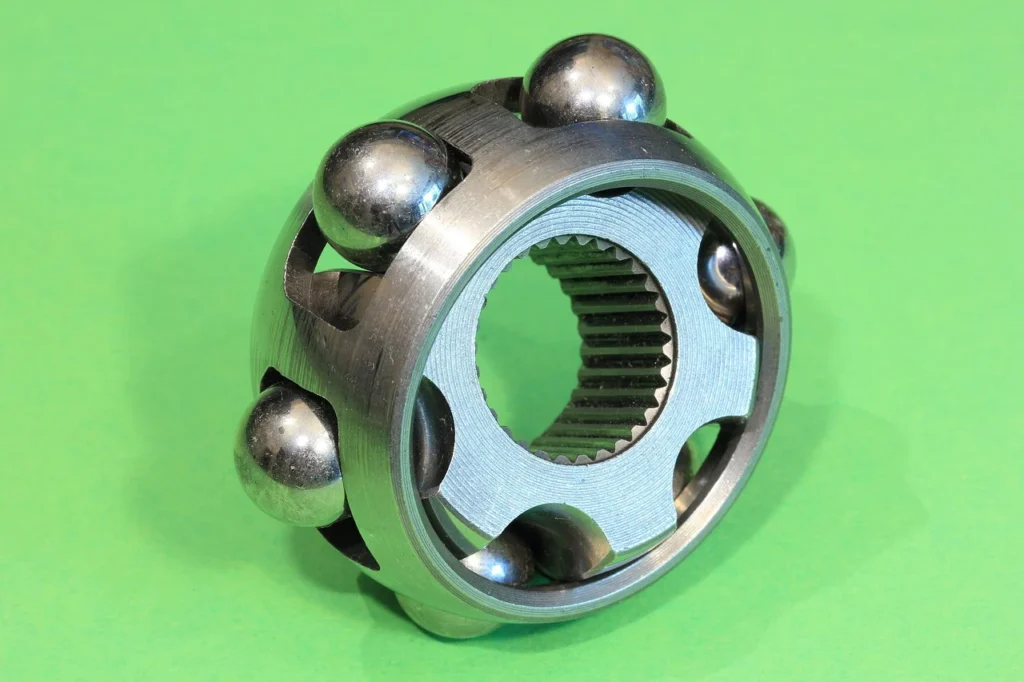
The clicking noise a worn CV joint makes on tight turns is one of the more recognisable fault sounds a car produces, and it’s also one of those faults where catching it early genuinely changes the cost of fixing it. A split boot gaiter caught quickly can sometimes mean a comparatively cheap repair, while the same fault left unaddressed for months usually means a considerably more expensive full joint replacement.
Why the boot gaiter matters so much
The rubber boot gaiter’s job is to keep grease inside the CV joint and dirt, water, and road grit out. Once it splits or tears, that seal is broken, grease is gradually flung out and contamination gets in, and the joint itself, without proper lubrication and now exposed to grit, wears out relatively quickly from that point onward. If a torn boot is spotted before the joint itself has started clicking or showing play, replacing just the boot and repacking it with fresh grease can be a genuinely effective, more affordable fix.
When a full joint replacement becomes necessary
- Clicking or popping noise on full steering lock, a classic sign of joint wear already underway
- Visible play or looseness when the driveshaft is checked by hand
- A boot that’s been split for an unknown length of time, meaning contamination has likely already occurred
- Vibration through the car that increases with speed, on some inner joint failures
Once the joint itself shows wear, a boot-only repair won’t resolve the noise or the underlying damage, and a full joint, or in many cases the complete driveshaft assembly, needs replacing instead.
Typical cost breakdown
A boot gaiter replacement, including fresh grease and labour, typically costs somewhere between £70 and £140 depending on the vehicle and how accessible the joint is. A full CV joint or driveshaft replacement runs considerably higher, generally £150 to £320 depending on whether it’s supplied as an individual joint or a complete driveshaft assembly, which is how many cars are set up to be serviced.
Driveshaft assemblies versus individual joints
On many modern cars, the inner and outer CV joints are not sold as separate serviceable parts but as part of a complete driveshaft assembly, meaning a full joint replacement often means replacing the whole shaft rather than just the failed joint at one end. This affects pricing directly, since a complete assembly costs more than a single joint would in isolation, but it also reflects how these components are actually manufactured and supplied by most parts suppliers.
Where a genuinely serviceable individual joint is available for your specific vehicle, it can offer a worthwhile saving over a full assembly, which is worth asking about directly when getting a quote rather than assuming the more expensive option is the only one available.
Regularly checking CV boots for splits during routine servicing is one of the cheapest, most effective ways to avoid this repair turning into a bigger bill, since catching a torn boot within days or weeks, rather than months, is usually the difference between a boot-only fix and a full joint replacement.
It is worth having driveshafts checked as part of any routine service inspection, particularly on cars that regularly cover rough or unsurfaced roads, since a visual check of the boots takes only moments but can catch a developing fault well before it becomes audible or noticeable through the steering.
Inner CV joints, closer to the gearbox, are somewhat less exposed to road debris than outer joints but can still fail, often producing a vibration that increases with speed rather than the classic clicking noise associated with outer joint wear on tight turns.
What happens if you ignore a split boot
A split boot left unaddressed almost always progresses to a worn, clicking joint within a relatively short number of miles, since the contamination and lost lubrication accelerate wear quickly once it starts. Left even longer, a severely worn joint can eventually fail completely while driving, which affects the car’s ability to transmit drive to that wheel and is a genuine safety concern, not just a noise issue.
What a mechanic actually checks before quoting this repair
Beyond listening for the clicking noise on full lock, a proper inspection includes physically checking the boot for tears or splits, feeling for play in the joint by hand with the driveshaft supported, and checking for grease flung around the inside of the wheel or nearby components, which is a fairly reliable visual sign that a boot has been compromised for some time. The technician will also check the inner joint, closer to the gearbox, separately from the outer joint, since these wear differently and produce different symptoms, and a repair quote should be clear about which specific joint is affected rather than treating the driveshaft as a single undifferentiated unit.
How CV joint noise compares with other driveline sounds
A clicking or clunking noise isn’t always the CV joint. Worn wheel bearings can produce a droning noise that changes with speed rather than steering input, while a failing differential or gearbox mount can produce clunks under acceleration or deceleration that are sometimes mistaken for CV joint symptoms. The classic full-lock clicking noise is a fairly distinctive, reliable indicator specifically pointing toward an outer CV joint, which is one of the more straightforward diagnoses in this category precisely because the symptom is so characteristic.
Why grease type and quantity matters for boot-only repairs
When a boot-only repair is genuinely viable, using the correct grease type and quantity for that specific joint matters more than it might seem, since CV joint grease is a specialised, high-temperature formulation designed to handle the joint’s constant flexing and rotation, and using the wrong type or too little can shorten the repaired joint’s remaining life considerably. A proper boot replacement includes thoroughly cleaning out any old, potentially contaminated grease before repacking with fresh grease of the correct specification, rather than simply adding new grease on top of whatever remains.
Why West Yorkshire’s rural roads accelerate this wear
Unsurfaced tracks, potholed rural lanes, and the general wear and tear from hillier routes around the Calder Valley and similar areas expose CV boots to more flexing and more debris than smoother, flatter urban roads, which is part of why drivers doing a lot of rural driving in this region sometimes see boot splits and joint wear appear somewhat sooner than the general mileage guidelines would suggest. A quick visual boot check during any routine service is a genuinely worthwhile habit for drivers covering these kinds of roads regularly.
Frequently asked questions
Can I keep driving with a clicking CV joint for a while? Short term yes, if the noise is mild and only on full lock, but the wear will progress and the joint’s remaining service life shortens considerably the longer it’s driven on before repair.
Is it worth replacing both driveshafts at once if only one is clicking? Not automatically, since the other side may genuinely be fine, but it’s worth having both checked properly during the same visit given they typically see similar mileage and use.
What happens during CV joint or driveshaft replacement in practice
The driveshaft is disconnected from the hub and, depending on the vehicle, from the gearbox or differential end too, before being removed as a complete unit for a full assembly replacement, or with just the affected joint disassembled where an individually serviceable joint is genuinely available. Fresh grease of the correct specification is packed into the new or repaired joint before the boot is fitted and secured with new clips, since reusing old, stretched clips risks the very same seal failure that caused the original problem. The car is road tested afterward, checking specifically that the clicking noise on full lock has genuinely gone rather than simply assuming a new part has resolved it.
Frequently asked questions: can a driveshaft be reused if only the boot has failed and the joint itself tests fine? Yes, this is exactly the scenario where a boot-only repair is genuinely the sensible, more affordable option rather than a full assembly replacement.
Why this repair is worth prioritising once symptoms start
Given how directly and quickly a split boot progresses toward needing a full joint replacement, this is genuinely one of the clearer cases where prompt attention makes a meaningful financial difference, turning what could be a modest boot-only repair into a considerably larger bill purely as a function of how many weeks or months pass before it’s addressed.
A simple way to check your own CV boots
With the car safely raised, a visual check of each rubber boot for splits, tears, or grease flung around the inside of the wheel takes only a minute and is something many owners can reasonably do themselves between services, giving an early warning worth acting on promptly if anything looks amiss.
Why noting exactly when the clicking started helps diagnosis
Being able to tell a mechanic roughly how long the clicking has been present, and whether it’s stayed the same or gradually got worse, helps them judge how much progression has likely occurred and therefore how confident they can be in a boot-only repair being sufficient versus recommending the more thorough full joint replacement from the outset.
It is also worth asking whether the technician checks the opposite driveshaft as standard during the same visit, given how closely matched wear tends to be between the two sides on most vehicles doing consistent, even mileage.
None of this needs to feel overwhelming. A clear explanation of whether your specific fault is boot-only or joint-level helps you understand exactly what you are paying for and why.
How CV joint health connects to overall drivetrain reliability
A driveshaft transmitting power unevenly, due to a worn joint, places additional strain on the gearbox output and the wheel bearing at that corner too, since none of these components were designed to handle the slightly irregular motion a failing joint introduces. Left long enough, a badly worn CV joint doesn’t just risk failing itself, it can contribute to accelerated wear in the components immediately connected to it, which is another reason prompt attention to this fault protects more than just the joint in isolation.
A final word on catching this fault early
Given how directly the cost of this repair scales with how long a split boot has gone unaddressed, this is genuinely one of the clearer examples of where a small amount of proactive attention saves real money down the line.
A brief mention of your typical driving environment, particularly if you regularly use unsurfaced tracks or very rough rural roads, helps a mechanic judge how proactively future boot checks might be worth scheduling compared with the general guidelines that apply to more typical road use.
Finally, having driveshaft boots checked as a standard part of routine servicing, rather than only when a noise prompts concern, is one of the simplest and cheapest ways to avoid this fault ever progressing to a full joint replacement in the first place.
Taking the time to have both driveshafts checked properly, rather than assuming only the noisy side needs attention, tends to give a more complete and accurate picture of your car overall driveline condition.
Taking these small preventative checks seriously, boot condition in particular, remains the cheapest and easiest way to avoid this fault ever progressing to a full driveshaft replacement.
Getting a second opinion before committing to a full assembly replacement is always reasonable, particularly if a quote falls outside the typical ranges discussed here.
Booking this early rather than waiting for a full clunk to develop tends to keep the eventual bill on the smaller, more manageable end of the scale.
A short conversation about your typical mileage helps a mechanic judge how the remaining service life of the repaired side compares with the healthy one.
If you’ve heard clicking on tight turns, or spotted grease flung around the inside of a wheel, it’s worth having your driveshafts and CV joints checked promptly. See the RAC’s driveshaft and CV joint advice for more background, then get your instant quote today.
Frequently asked questions
Can a split CV boot be fixed without replacing the joint?
Yes, if caught early before the joint itself shows wear, replacing the boot and repacking with fresh grease is often an effective, more affordable fix.
Why does my car click when turning?
Clicking on full steering lock is a classic sign of a worn outer CV joint, usually caused by a split boot that went unnoticed for some time.
Is it safe to drive with a clicking CV joint?
For a short time it is usually manageable, but the wear progresses and a severely worn joint can eventually fail, so it should be checked promptly.
How often should CV boots be checked?
A visual check as part of any routine service is sensible, since a split boot is easy to spot early and cheap to fix at that stage.