

A 50-point health check sounds thorough on paper, but most drivers booking one have never actually seen a list of what’s included, which makes it hard to know whether it’s genuinely worth doing or just a marketing phrase. It’s neither an MOT nor a full service, it sits somewhere in between, giving you a clear picture of your car’s condition without the cost or time commitment of a complete strip-down inspection.
What a health check actually is
A health check is a structured visual and functional inspection covering the major systems that affect safety, reliability and running costs. Unlike an MOT, which only tests against the legal minimum standard required to keep a car on the road, a health check looks more broadly at wear, condition and anything likely to need attention in the near future, even if it wouldn’t currently fail a test. It’s designed to flag developing issues while they’re still cheap to fix.
The braking system checks
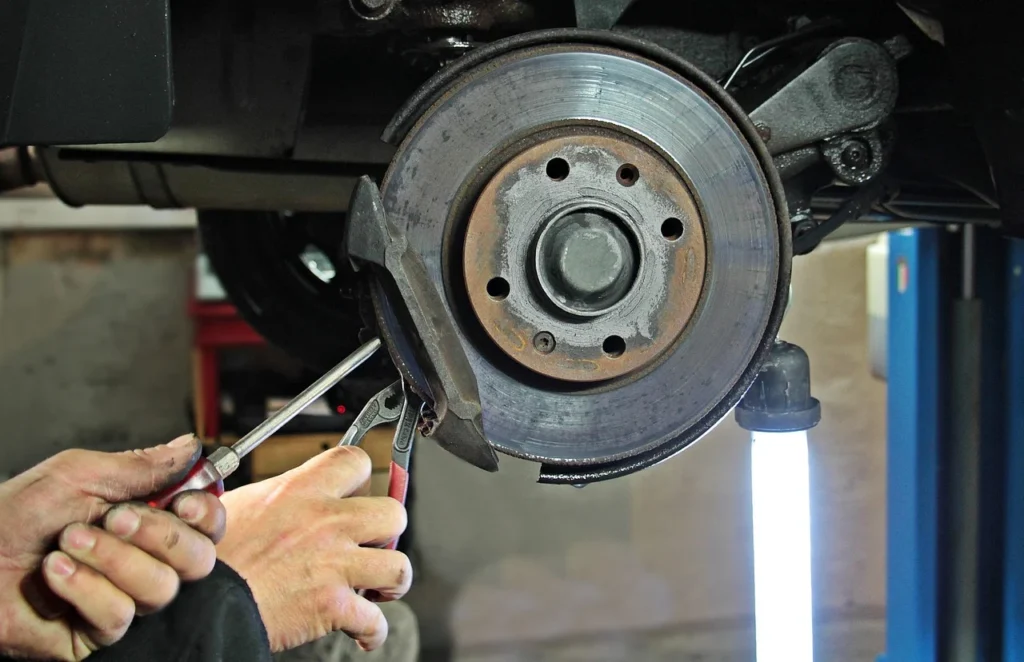
Brakes are usually one of the most detailed sections. This includes measuring pad and disc thickness, checking for uneven wear, inspecting brake lines and hoses for damage or corrosion, testing the handbrake, and checking brake fluid condition and level. Since brake fluid absorbs moisture over time and becomes less effective, its condition is often assessed even outside a full fluid change, since degraded fluid affects braking performance under hard use.
- Brake pad and disc thickness and wear pattern
- Brake fluid level and condition
- Handbrake operation and adjustment
- Brake lines, hoses and connections for leaks or corrosion
Suspension, steering and tyres
This section covers shock absorbers, springs, bushes and ball joints for wear, play or damage, along with steering components and power steering fluid where applicable. Tyres get checked for tread depth across the width of each tyre, uneven wear patterns that might point to alignment or suspension issues, sidewall damage, and correct pressure, including the spare if the car has one.
Under the bonnet: fluids and belts
Engine oil level and condition, coolant level and concentration, screen wash, power steering fluid and clutch fluid where fitted are all checked, along with a visual inspection of drive belts and hoses for cracking, fraying or perishing. Battery condition and terminal connections are usually tested here too, since a weak battery is one of the most common causes of unexpected breakdowns.
Electrics and lighting
All exterior lights, indicators, brake lights, fog lights and number plate lighting get checked for function, along with dashboard warning lights, the horn, wipers and washers. This section is quick but important, since a single blown bulb is an easy MOT fail that’s genuinely simple to catch and fix well before your test date.
Exhaust, emissions and underbody
The exhaust system is inspected for leaks, corrosion and secure mounting, and where relevant, a basic assessment of emissions-related components is included. The underbody gets a visual check for corrosion, damage or fluid leaks that wouldn’t necessarily be obvious from inside the car or under the bonnet.
Why it’s worth doing before an MOT
Booking a health check a few weeks before your MOT is due gives you time to address anything flagged without the pressure of a test deadline. It also means fewer surprises on the day itself, since most of the common MOT fail points, lighting, tyres, brakes, fluid leaks, are exactly what a thorough health check covers. Many drivers find it’s cheaper overall to catch and fix issues on their own schedule rather than under the time pressure of a failed test.
What you get at the end
A proper health check should leave you with a clear written or verbal summary of what was checked, what’s fine, what’s wearing but not urgent, and what needs attention soon. That clarity is really the main value of the whole exercise, it turns vague uncertainty about your car’s condition into a specific, prioritised list you can act on at your own pace.
Booking a check with SSK Mechanics
Because the check is carried out at your home or workplace, there’s no need to sit in a waiting room or arrange alternative transport for the day. It typically takes under an hour depending on the vehicle, and gives you a genuinely useful snapshot of where your car stands before your next MOT or long journey.
Why the number 50 varies between providers
You’ll see health checks marketed as 30-point, 50-point or even 70-point inspections, and the differences often come down to how granularly each check is broken into individual line items rather than a meaningfully different scope of work. A shorter list might combine “front brakes” into one line where a longer list splits it into pads, discs, calipers and lines separately. What actually matters more than the headline number is whether the check covers braking, suspension, tyres, fluids, electrics and the exhaust system in reasonable depth, which any genuinely thorough health check should.
How a health check differs from a full service
A full service typically includes the health check items plus actually carrying out scheduled maintenance work, oil and filter changes, and replacement of components due by mileage or age, such as spark plugs or air filters. A health check on its own is purely diagnostic, it tells you what’s needed without carrying out the work itself. Many drivers use a health check as a way to understand what a forthcoming service is likely to cost before committing, particularly useful if budgeting for a larger job like brakes or suspension work alongside routine servicing.
Interpreting a red, amber, green style report
Many health check reports use a simple colour system, green for fine, amber for wearing but not urgent, red for needs attention soon. This is a genuinely useful way to prioritise your own to-do list without needing to understand the technical detail behind each item. Reds are worth addressing promptly, ambers are worth keeping an eye on and budgeting for over the coming months, and greens need nothing beyond normal ongoing use. It turns a long technical list into something you can actually act on sensibly.
Getting the most value from your check
Ask for the specific measurements where relevant, brake pad thickness in millimetres, tyre tread depth, rather than just a pass or fail note, since this lets you track wear over time between checks. It’s also worth mentioning anything unusual you’ve noticed yourself, a new noise, a vibration, a dashboard light, so the mechanic can pay particular attention to that area during the inspection rather than relying purely on the standard checklist.
Health checks for older versus newer cars
Older cars generally benefit from more frequent health checks since more components are approaching or past their expected working life simultaneously, increasing the chance of something needing attention at any given check. Newer cars under warranty still benefit from independent checks between main dealer services, partly for peace of mind and partly because independent mechanics sometimes catch developing issues that a manufacturer’s fixed service schedule doesn’t specifically look for until a later, scheduled interval.
Why a mobile health check suits busy schedules
Fitting a garage visit around work, school runs and general daily life is one of the more tedious parts of car ownership, arranging drop-off, alternative transport, and collection later in the day. A mobile health check removes that friction entirely, the mechanic comes to your home or workplace car park, and you carry on with your day nearby rather than losing hours to a waiting room. For many drivers, this convenience is what finally gets a long-overdue check actually booked in.
What happens after the check if work is needed
If the check flags something needing attention, a good provider will explain the finding clearly, give you a fair sense of urgency, this week, this month, keep an eye on it, and provide a straightforward quote for the work itself. You’re under no obligation to have the work carried out immediately or by the same provider, though booking it in during the same visit, where the fault allows, saves arranging a second appointment for work you already know is needed.
Combining a health check with other planned work
If you already know a service or repair is coming up, booking a health check at the same time makes sense, since the mechanic is already there and has access to the vehicle. It also means any additional findings can be quoted and scheduled together rather than requiring a separate visit and separate call-out, which is usually the more cost effective way to handle routine maintenance over the course of a year.
Why documentation matters for resale value
A folder of health check reports showing consistent, proactive maintenance is a genuinely useful thing to have if you sell the car later. It demonstrates to a buyer that the vehicle has been looked after beyond the bare minimum required for an MOT pass, which can support a stronger asking price and give a buyer more confidence in the purchase, particularly for private sales where trust between buyer and seller matters more than it does through a dealer.
Health checks for cars used for business or trade work
Vehicles used daily for trade work, deliveries or client visits carry a higher cost when something goes wrong unexpectedly, a missed job, a stranded appointment, lost income for the day. Regular health checks for these vehicles aren’t just about maintenance, they’re a practical way of protecting the reliability the business depends on, catching developing issues on your own schedule rather than finding out about them at the worst possible moment during a busy working day.
Setting a realistic check schedule for your own car
There’s no single perfect interval that suits every car and every driver, but a reasonable starting point is a health check roughly every six months, or annually paired with a pre-MOT check for lower mileage drivers. Adjust based on your own car’s age, mileage and how it’s used, older or higher mileage vehicles, and those used for demanding work, generally benefit from more frequent checks than a newer car covering modest annual mileage.
How technology has changed what a health check can spot
Modern diagnostic equipment can now read fault codes and live sensor data directly from a car’s onboard computer during a health check, catching electronic and sensor-related issues that a purely visual inspection would miss entirely. Combined with the traditional hands-on checks, this gives a considerably more complete picture of a vehicle’s condition than was possible on older cars without the same level of onboard electronics, particularly useful for spotting emissions or engine management issues before they trigger a dashboard warning light.
Why consistency between checks matters
Using the same mechanic or provider for repeat health checks means measurements and observations can be compared directly over time, brake pad thickness at six months versus a year ago, for example, giving a much clearer sense of the rate of wear than a single snapshot check ever could. That kind of trend data helps predict when a component is likely to need replacing well before it becomes urgent, letting you plan and budget rather than react.
Making health checks a genuine habit rather than an afterthought
Cars that receive regular, consistent health checks tend to cost their owners less over the life of the vehicle than those only ever looked at when something has already gone wrong. Small, cheap fixes caught early prevent larger, more expensive failures later, and that principle alone makes a modest, regular health check one of the more sensible ongoing investments any car owner can make, regardless of the age or value of the vehicle itself.
If it’s been a while since your car had a proper look-over beyond the bare minimum an MOT requires, a health check is a sensible, low-hassle way to close that gap and get a clear, honest picture of exactly where things stand.
Booking one is straightforward, takes very little of your day given the mobile format, and gives you genuine, specific information rather than a vague sense of reassurance, which is really what most drivers are actually looking for when they ask how their car is doing.
Source: gov.uk's guidance on MOT testing
Frequently asked questions
Is a 50-point health check the same as an MOT?
No, an MOT tests against the legal minimum standard to keep a car on the road, while a health check looks more broadly at wear and condition, including things that would not currently fail a test.
How long does a health check take?
Most health checks take under an hour depending on the vehicle, and can be carried out at your home or workplace rather than requiring a garage visit.
Will a health check tell me if my car will pass its MOT?
It will not guarantee a pass, but it covers most of the common MOT fail points, so it gives a strong indication of where problems are likely to arise.
Does a health check include fluid top-ups?
It typically includes checking fluid levels and condition rather than full top-ups or changes, though any needed can usually be arranged during the same visit.
How often should I book a health check?
Once or twice a year, or a few weeks before your MOT is due, is a sensible interval for most drivers and vehicles.