

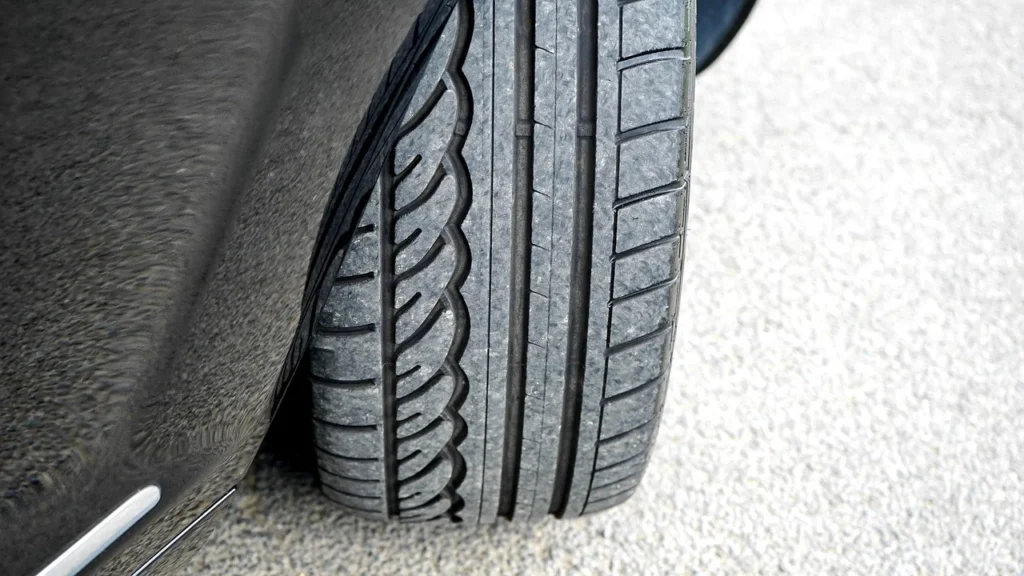
Tyres are one of the most straightforward things to check on your own car, and yet tread-related faults remain one of the most common reasons UK cars fail their MOT every single year. Knowing exactly what the legal limit is, how testers assess it, and how to check it yourself removes almost all of the guesswork around what’s genuinely one of the easiest fail categories to avoid.
Tyres are also the only part of the car that actually touches the road, which makes their condition directly relevant to how well your car stops, steers and holds its line, particularly in wet or icy conditions. Treating tread depth as just an MOT checklist item undersells how much it actually matters for everyday safety.
The legal minimum in the UK
The legal minimum tread depth for cars and light vans in the UK is 1.6mm, measured across the central three-quarters of the tyre’s width, and it needs to meet that minimum all the way around the tyre’s circumference, not just at one point. A tyre can look fine at a glance from one angle and still fail if a section further round has worn down more than the rest, which is why testers check multiple points rather than relying on a single measurement.
How testers actually measure it
MOT testers use a proper tread depth gauge, which gives a precise reading rather than relying on a visual estimate. They check several points around the circumference of each tyre and across the central band, since wear isn’t always even, and a tyre that’s fine in one spot can be below the limit just a few inches around. Any tyre found below 1.6mm anywhere in that central three-quarters zone results in a fail for that tyre, and the fail is per tyre, so multiple worn tyres compound the problem on the test report.
Checking your own tyres with a 20p coin
A widely used and genuinely reliable trick is inserting a 20p coin into the main tread grooves at a few different points around each tyre. The outer rim of a 20p sits at roughly the legal minimum depth, so if that outer band is still visible once the coin is pushed into the groove, the tyre is likely close to or below the legal limit and worth getting properly checked with a gauge. Doing this at three or four points around each tyre, rather than just once, catches the uneven wear that a single check would miss.
- Check tread at multiple points around each tyre, not just one spot
- Look for uneven wear on the inner or outer edge, which can signal an alignment issue
- Check for cuts, bulges or exposed cord alongside tread depth
- Don’t forget the tyre that’s hardest to see, often the rear offside
- Check tyre pressures at the same time, since underinflation accelerates uneven wear
Why tyres wear unevenly
Even wear across a tyre’s surface is normal and expected with age and mileage. Uneven wear, particularly concentrated on the inner or outer edge, is usually a sign of something else going on, most commonly incorrect wheel alignment or worn suspension components. Fitting new tyres without addressing the underlying cause of uneven wear tends to result in the same pattern repeating on the new set, which is an expensive way to keep solving the same problem repeatedly rather than fixing it properly once.
Age matters as much as tread depth
A tyre with plenty of tread remaining can still be unsafe if it’s old enough that the rubber compound has started to perish. Most tyre manufacturers recommend replacement after around ten years regardless of how much tread is left, since ageing rubber can develop cracks and lose grip performance even without visible tread wear. The tyre’s date of manufacture is stamped on the sidewall as a four-digit code, the first two digits for the week and the last two for the year, and it’s worth checking this on any tyre you’re unsure about, particularly on a car that’s covered relatively low mileage over a long period, since low mileage doesn’t automatically mean the tyres are still in good condition.
Wet weather and seasonal considerations
Tread depth matters most in exactly the conditions where you need grip the most: heavy rain, standing water, and icy or wet roads across Bradford and the wider West Yorkshire area through autumn and winter. A tyre right at the legal minimum has significantly less capacity to disperse water than a tyre with generous tread remaining, which increases the risk of aquaplaning at speed. Many safety organisations recommend replacing tyres well before they reach the bare legal minimum, particularly for anyone regularly driving on faster roads or in poor weather, rather than waiting until the exact 1.6mm threshold before considering new tyres.
What it costs to get this wrong
Beyond the MOT fail itself, driving on illegal tyres carries its own separate penalty regardless of whether you’re stopped during an MOT or simply pulled over by the police. Each illegal tyre can result in a fine and points on your licence, and because the penalty applies per tyre, a car running on four worn tyres can face a considerably larger combined penalty than most drivers expect, on top of the cost of replacing the tyres themselves.
Tyre types, mixing and what’s allowed
UK law also has specific rules around mixing different tyre types across an axle in a way that could affect handling. Fitting a different tread pattern or tyre construction type across the same axle, in a combination that affects the car’s handling characteristics, can result in an MOT fail even if both individual tyres meet the tread depth requirement on their own. This catches people out most often when only one or two tyres are replaced at a time rather than a full set, and the new tyre ends up being a noticeably different type or brand to the ones remaining on the car. It’s worth asking whoever fits your tyres whether a partial replacement is genuinely suitable for your specific car, since some vehicles are more sensitive to this than others.
Run-flat tyres, all-season tyres and winter tyres each come with their own specific considerations too. Mixing run-flats with standard tyres, for example, is generally not recommended due to the difference in sidewall stiffness, which can affect handling balance across the car even if both types individually meet legal tread requirements.
Winter tyres and West Yorkshire’s hillier routes
While winter tyres aren’t a legal requirement in the UK the way they are in some other European countries, they’re worth considering for anyone regularly driving West Yorkshire’s hillier, more exposed routes through the colder months. Standard tyres lose a meaningful amount of grip once temperatures drop consistently below around seven degrees, since the rubber compound stiffens in the cold, while winter-specific compounds are designed to stay flexible and maintain grip in exactly those conditions. For drivers regularly tackling steep or icy roads around Bradford in winter, a dedicated set of winter tyres, swapped seasonally, can make a genuine difference to grip and stopping distance, on top of simply keeping standard tyres within the tread depth and condition limits covered by the MOT.
Spotting a slow puncture before it becomes a problem
A slow puncture can gradually reduce tyre pressure over days or weeks without being obviously noticeable, particularly on cars without a tyre pressure monitoring system that alerts the driver directly. Checking pressures regularly, ideally monthly, catches a slow puncture long before it becomes a flat tyre at an inconvenient moment, and it also catches the kind of gradual underinflation that accelerates uneven tread wear even without an actual puncture being present. A tyre that consistently needs topping up more often than the others is worth investigating properly rather than just repeatedly adding air and hoping it resolves itself.
Making tyre checks a habit, not just an MOT prep step
Checking tread depth and general tyre condition regularly, not just in the days before an MOT, catches problems while there’s still time to plan for new tyres rather than needing them immediately. A full 50-point health check includes a proper tyre inspection alongside the areas that are harder to assess yourself, giving you a complete picture of where your tyres actually stand well before test day. You can find further detail on the legal requirements for tyres on gov.uk’s tyre law guidance, which covers the full legal position in more depth.
Budgeting for tyre replacement
Tyres are one of the more predictable costs of car ownership, since wear happens gradually and is easy to track if you’re checking tread depth periodically rather than only at MOT time. Watching tread depth decline over several months gives you a rough idea of when replacement will be needed, which means you can plan and budget for it rather than being caught out by a sudden fail or, worse, a blowout caused by tyres that were left too long. Buying tyres in pairs or as a full set when possible, rather than one at a time reactively, also tends to work out more cost effective and avoids the mismatched tyre type issue covered earlier.
Prices vary considerably depending on tyre brand, size and specification, and it’s worth getting more than one quote for a full set rather than assuming the first price you’re given is competitive, since the difference between a budget and premium tyre of the same size can be substantial, and the right choice depends on how the car is used rather than simply picking the cheapest option available.
How tyre wear interacts with other MOT categories
Tyre condition rarely exists in isolation from the rest of the car’s running gear. Uneven wear concentrated on one edge is often the clearest visible symptom of a wider steering or suspension problem, meaning a tester spotting one issue during the tyre check will often flag the other as a related advisory even if it hasn’t yet progressed to an outright fail. Similarly, a tyre that’s noticeably underinflated puts additional strain on the sidewall and can affect how the car responds during the brake test, since grip and stopping distance are directly affected by how much of the tread is actually in contact with the road at the correct pressure. Treating tyres as connected to steering, suspension and braking, rather than as an entirely separate category, gives a more accurate picture of what a specific pattern of wear is actually telling you about the car.
Space-saver spares and temporary tyres
Many newer cars come with a space-saver spare rather than a full-size matching wheel, and it’s worth knowing the rules around these before you need one urgently. A space-saver is legal to drive on but comes with a speed restriction, usually around 50mph, clearly marked on the tyre’s sidewall, and it’s intended as a genuinely temporary measure to get you to a garage rather than something to leave fitted for an extended period. Driving on a space-saver beyond its intended limits, or leaving one fitted for weeks while putting off replacing the damaged tyre properly, isn’t itself an MOT item if the space-saver meets the legal tread and condition requirements, but it’s worth remembering the handling and braking characteristics of a space-saver are noticeably different from a full-size tyre, particularly in wet conditions.
Some newer cars skip a spare tyre entirely in favour of a tyre repair kit or run-flat tyres designed to be driven on for a limited distance even after a puncture. If your car falls into this category, it’s worth knowing exactly what’s provided and its limitations before you’re relying on it at the roadside in the rain, since a repair kit won’t help with a sidewall puncture or a tyre that’s shredded rather than simply punctured cleanly.
Why this is one of the easiest MOT categories to control
Unlike suspension wear or structural corrosion, which often need a trained eye and a ramp to properly assess, tyre condition is something almost any driver can check accurately themselves with nothing more than a coin and a few minutes. That makes tyre-related MOT fails genuinely avoidable in a way that some other fail categories aren’t, and it’s exactly why they remain frustrating when they do happen, since the warning signs are almost always there to spot beforehand if you know what to look for and make the time to look.
Source: gov.uk's tyre law guidance
Frequently asked questions
What is the legal minimum tyre tread depth in the UK?
It is 1.6mm across the central three-quarters of the tyre, measured around the entire circumference, for cars and light vans.
Can I check tread depth myself without special tools?
Yes, a 20p coin inserted into the tread groove is a widely used trick. If the outer band of the coin is visible, the tread is likely close to or below the legal limit.
Does tyre age matter even if tread looks fine?
Yes, tyres can perish and crack with age even with plenty of tread remaining, and most manufacturers recommend replacement after around ten years regardless of tread depth.
Is the spare tyre checked during an MOT?
No, the spare is not tested unless it is fitted as one of the four road wheels being used on the car at the time of the test.
What is the penalty for driving on illegal tyres?
Each illegal tyre can carry a fine and points on your licence, so a car with four illegal tyres can face a considerably larger combined penalty than most drivers expect.