

Blue or bluish grey smoke from the exhaust means engine oil is burning inside the combustion chamber instead of staying where it should, in the sump and moving parts. It’s usually most noticeable on acceleration, on start up after the car’s been sat for a while, or on the overrun when you lift off the throttle going downhill.
This isn’t a fault that appears overnight in most cases. It tends to develop gradually as wear builds up, which is exactly why it’s worth catching early rather than waiting for it to get worse.
What causes blue smoke
Oil finds its way into the combustion chamber through a limited number of routes, so the diagnosis usually comes down to one of these:
- Worn piston rings, letting oil past from the crankcase into the cylinder, usually more noticeable under load or acceleration
- Worn valve stem seals, which tend to leak oil down into the cylinder when the engine’s idling or on overrun, producing a puff of smoke rather than a constant stream
- A failing turbocharger, where worn oil seals inside the turbo let oil get drawn into the intake and burned, often with smoke on boost
- Overfilled engine oil, which is a far simpler and cheaper cause worth ruling out before assuming the worst
Higher mileage engines and cars that have covered a lot of short journeys are more prone to this, since rings and seals wear over time and short trips don’t always let the engine reach a temperature that keeps everything sealing properly.
How urgent is it
Blue smoke on its own doesn’t tend to leave you stranded the way an overheating fault might, but it’s a sign of internal wear that only gets worse with time, and it burns through oil faster than normal. Left unchecked, oil consumption can get to the point where you’re topping up regularly, and eventually low oil pressure risks damaging other parts of the engine. It will also fail an MOT on excessive smoke, and depending on severity it isn’t doing your spark plugs, catalytic converter, or oxygen sensors any favours either.
The RAC has useful drive advice on exhaust smoke colours if you want a general reference on what different smoke colours typically indicate before booking a check.
What a mechanic actually checks
Diagnosis usually starts with establishing when the smoke appears, on start up, under load, or on overrun, since that timing narrows down whether it’s rings, valve seals, or a turbo issue. A compression test or leak down test checks how well the rings and valves are sealing each cylinder. Oil consumption is checked against the level and condition on the dipstick, and if there’s a turbo fitted, it gets inspected for play in the shaft and signs of oil around the intake and exhaust housings.
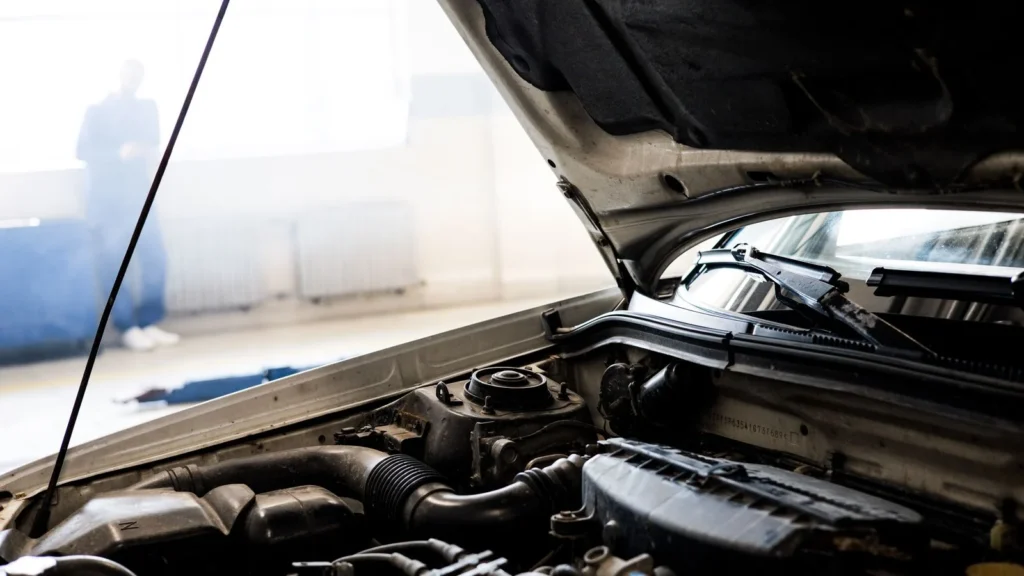
A wider look under the bonnet at this point is worth doing anyway, since an engine burning oil is often part of a broader pattern of wear that’s worth having flagged rather than dealt with one symptom at a time.
Book now or wait
If it’s a light puff on cold start that clears quickly, you’ve likely got some time, though it’s still worth having it looked at so you know what you’re dealing with. If the smoke is constant, getting heavier, or you’re noticing the oil level dropping between services, book it in. Catching wear early gives you options that waiting doesn’t.
What it typically costs to fix
Blue smoke means the engine is burning oil, and the fix depends on where it’s getting in. Worn valve stem seals are the cheaper cause, typically £200-400 to replace. Worn piston rings are a bigger job, often £600-1200, since it usually requires significant engine disassembly. A turbo with worn internal seals letting oil into the intake is another common source, typically £500-1200 to replace.
What happens if you leave it
An engine burning oil will keep losing oil between services, and if the level isn’t checked and topped up regularly, it risks running low, which causes far more serious and expensive damage than the original leak. Blue smoke also tends to worsen gradually rather than suddenly, so what’s a faint puff on start-up now is likely to become a more constant and noticeable smoke over time if left unaddressed.
What you can check yourself first
Check your oil level on the dipstick, since an engine burning oil will show a level that drops noticeably between checks even without a visible leak underneath. Note whether the smoke is worse on start-up and then clears, which often points to valve seals, or constant throughout the drive, which points more toward piston rings or a turbo issue.
How piston rings and valve seals actually fail
Piston rings sit around each piston and do two jobs: sealing combustion pressure above the piston and scraping excess oil off the cylinder wall so it drains back to the sump rather than being pulled up into the combustion chamber. As rings wear, usually from age, heat, and the sheer number of cycles they go through, the seal they provide weakens, and oil starts finding its way past them into the combustion chamber, particularly under load when cylinder pressure is highest. Valve stem seals work differently, sitting where the valve stem passes through the cylinder head, controlling how much oil is allowed to lubricate that moving part without letting excess oil drip down into the cylinder. When these seals harden and crack with age, oil pools around the valve stem when the engine’s off or idling, then gets pulled into the cylinder in a small puff once the valve opens, which is why valve seal wear often shows up most clearly right after start-up.
Turbocharger oil seals in more detail
A turbocharger spins at extraordinary speed, often well over 100,000rpm, and relies on a constant supply of engine oil both to lubricate its bearings and to help cool them. Seals on either side of the turbo’s centre section keep that oil contained to the bearing area, away from the intake and exhaust sides. As these seals wear, usually from age and the sheer heat a turbo generates, oil can seep past into the intake tract, where it gets drawn into the engine and burned, producing blue smoke that’s often most noticeable under boost, when the turbo is working hardest and airflow through it is at its greatest. A failing turbo can also produce a distinct whining or whistling change in sound alongside the smoke, which is a useful additional clue for a mechanic trying to distinguish a turbo issue from ring or seal wear elsewhere in the engine.
Why catching this early matters
An engine that’s burning a small, stable amount of oil is a very different proposition to one where consumption is accelerating month on month. Catching the problem while it’s still in the early stages, whether that’s a valve seal starting to leak or a turbo seal just beginning to wear, generally means a smaller, more contained repair. Left to progress, worn rings can eventually affect compression enough to reduce power noticeably, and a turbo that’s lost enough oil seal integrity can eventually fail outright, sometimes dramatically, which is a considerably more expensive repair than catching the early signs of wear.
What driving style does to oil consumption
Engines that spend a lot of time at low, gentle revs around town, without ever being driven at higher, sustained speeds, tend to accumulate carbon deposits around the rings that can actually worsen an existing ring wear problem by preventing the rings from seating and sealing as well as they otherwise might. Conversely, an occasional longer, higher-revving drive, done safely and appropriately, can sometimes help keep rings cleaner and seated properly, though it won’t reverse genuine wear once it’s set in. This is one of the few situations where a mix of driving styles genuinely benefits long-term engine health rather than one style being straightforwardly better than another.
What to expect during a mobile inspection
A mobile visit for blue smoke typically starts with establishing exactly when the smoke appears, since that timing alone narrows things down considerably before any testing begins. From there, a compression or leak-down test can be carried out at your home or workplace using portable equipment, giving a genuine picture of how well each cylinder is sealing without needing a workshop ramp. Oil level and condition get checked at the same time, and if a turbo is fitted, its shaft play and any oil staining around the intake get inspected as part of the same visit.
How this compares to black smoke
It’s easy to mix up blue smoke with black smoke if you’re not sure what to look for, but the two point toward very different faults. Blue smoke, from burning oil, tends to have a distinct bluish or grey tint and is often more noticeable against a light background or in bright sunlight. Black smoke, from unburned fuel, is a flatter, sootier colour and often has a stronger fuel smell rather than the faintly oily smell that accompanies blue smoke. If you’re genuinely unsure which you’re seeing, a photo or video taken safely, ideally against a plain background like a wall, can help a mechanic get a better sense of it before you even book anything in.
What you can check yourself before booking
Check your oil level on the dipstick and note whether it’s noticeably lower than it should be, since an engine burning oil will show this over time even without a visible external leak. Pay attention to whether the smoke is worse on a cold start and clears after a minute or two, which points more toward valve seals, or whether it’s present throughout the drive and particularly under acceleration, which points more toward rings or a turbo issue.
It is also worth mentioning any recent changes to your driving pattern or the type of journeys you have been doing, since a sudden shift toward more motorway driving, or conversely toward exclusively short trips, can sometimes bring an existing but previously minor amount of wear to your attention for the first time, even though the underlying wear itself was not new.
A leak-down test, in particular, gives a more detailed picture than a simple compression test alone, since it measures how quickly air escapes a cylinder once it has been pressurised, and where that air is escaping to, whether past the rings, past a valve, or into the cooling system, which helps confirm rings specifically as the cause rather than a different fault that happens to produce a broadly similar symptom.
Keeping a simple log of when you top up oil and roughly how much you add each time gives a mechanic real, measurable data on consumption rate over weeks or months, which is far more useful for tracking whether a repair has actually worked than relying on memory or a rough impression that the smoke seems a bit better or worse than before.
Worth noting too that some oil additives marketed as ring or seal restorers exist, and while a small number of drivers report a mild improvement in very early, minor cases, they are not a reliable fix for genuine wear and should not be relied upon as an alternative to a proper diagnosis and repair once a mechanic has confirmed the actual cause.
A car that has recently had an oil change with the wrong grade or a poor quality oil is also worth double checking, since using an unsuitable oil viscosity over an extended period can accelerate wear on rings and seals beyond what normal ageing alone would cause.
SSK Mechanics runs a full engine health check at your home or workplace across Bradford and West Yorkshire, covering compression and oil condition alongside a visual inspection of the turbo where fitted, giving you a genuine picture of what’s driving the smoke before recommending any repair.
SSK Mechanics runs a full 50-point health check at your home or workplace across Bradford and West Yorkshire, covering compression, oil condition, and turbo health alongside the wider mechanical picture. Get an instant quote and we’ll get a proper look at what’s going on.
Frequently asked questions
Is blue exhaust smoke dangerous?
It isn't an immediate safety hazard, but it means oil is burning inside the engine due to wear, and it will get worse and use more oil the longer it's left unchecked.
Can blue smoke be caused by too much engine oil?
Yes. Overfilling the engine can force excess oil into places it shouldn't be, causing smoke. It's worth checking the oil level before assuming worn rings or seals are to blame.
Will blue smoke fail an MOT?
Excessive smoke of any colour can result in an MOT failure, so it's worth having the cause diagnosed and addressed before your test is due.