

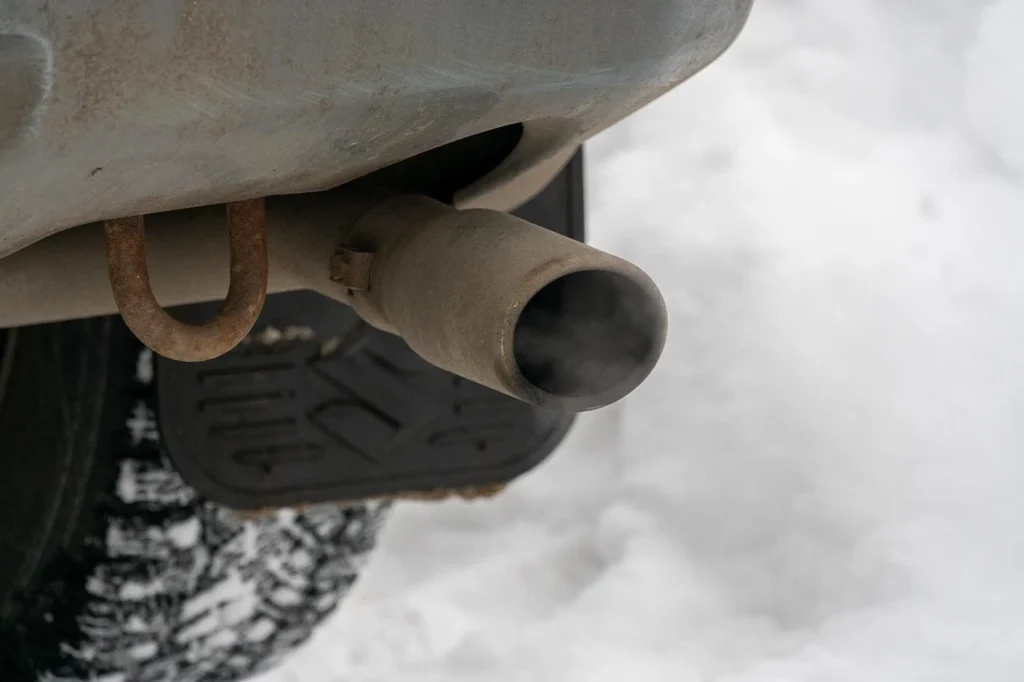
Black smoke from the exhaust means the engine is burning more fuel than it can properly combust, and the unburned excess is coming out as soot. On diesels it’s very often tied up with the diesel particulate filter (DPF), either because it’s blocked and forcing the engine to run rich, or because the conditions that would normally let it regenerate and clear itself just aren’t being met.
On petrol engines black smoke is less common but points in a similar direction: too much fuel, not enough air, or a combustion process that isn’t burning cleanly.
What causes black smoke
The likely causes differ slightly depending on fuel type, but generally come down to:
- A clogged or partially blocked DPF on diesels, which restricts exhaust flow and pushes the engine into a state where it runs rich to compensate
- A dirty or restricted air filter, starving the engine of air relative to the fuel being injected
- A faulty mass airflow sensor or boost pressure sensor giving the engine control unit the wrong information, causing it to inject too much fuel
- Failing or dirty injectors delivering fuel poorly, which is common on diesels that spend most of their time doing short, low speed journeys rather than motorway runs that let the DPF regenerate naturally
If the smoke gets noticeably worse under acceleration or when you put your foot down, that’s a strong hint it’s fuelling related rather than something more minor.
How urgent is it
Black smoke isn’t usually an immediate danger to the car’s mechanical health in the way white smoke is, but a blocked DPF that keeps getting worse can eventually cause the engine to go into limp mode, cutting power and limiting revs until it’s addressed. It’s also a guaranteed MOT emissions failure if it’s excessive, and driving with a heavily restricted DPF puts extra strain on the turbo and engine over time.
The gov.uk MOT emissions guidance sets out the smoke and emissions limits tested at MOT, which is a useful reference if you’re trying to work out how close you are to a failure.
What a mechanic actually checks
Diagnosis starts with reading fault codes and checking DPF related data, including soot loading if the system reports it, and looking at when the DPF last completed a successful regeneration. The air filter and intake system get checked for restriction, and sensors like the mass airflow sensor get tested against expected readings rather than just visually inspected.
If the DPF is confirmed as blocked but the filter itself is still structurally sound, a forced regeneration, sometimes combined with a deep clean, can burn off or flush out the built up soot without needing to replace the whole unit, which is a considerably cheaper route than a new DPF where it’s still viable.
Book now or wait
A little bit of black smoke on hard acceleration from a cold engine isn’t unusual and often isn’t worth panicking over. Smoke that’s heavy, constant, or getting worse, especially paired with reduced power or a dashboard warning light, needs sorting before it tips into limp mode or an MOT failure.
What it typically costs to fix
Black smoke almost always means the engine is burning too much fuel relative to air, and the fix depends on the cause. A blocked air filter is the cheapest, £15-30. A faulty MAF sensor or injector typically costs £60-250 depending on the part. On diesels, a failing turbo or a stuck EGR valve producing black smoke under load can run £150-1200 depending on which component has actually failed.
What happens if you leave it
Running rich for an extended period washes fuel past the piston rings and dilutes the engine oil, which accelerates wear on internal components that are expensive to fix compared with whatever caused the black smoke in the first place. It also tends to trigger an MOT failure on emissions, so it’s worth sorting before your next test rather than after.
What you can check yourself first
Check when the air filter was last changed, since a filter that’s overdue is the cheapest and most common cause and an easy first thing to rule out. Note whether the black smoke happens constantly or only under hard acceleration, since that detail helps a mechanic narrow down whether it’s a sensor, injector or turbo-related fault.
It’s also worth noting whether the smoke smells strongly of unburnt fuel, since that’s a useful detail for a mechanic even before any diagnostic scan is run. Diesel cars in particular can produce black smoke under hard acceleration even when nothing is seriously wrong, so a smoky puff on a rare full-throttle overtake is less concerning than smoke that’s there on every gentle acceleration.
How a DPF actually works and why it blocks
A diesel particulate filter traps soot particles from the exhaust in a honeycomb-like ceramic structure, preventing them from being released into the air. Over time, that trapped soot needs to be burned off in a process called regeneration, which requires sustained higher exhaust temperatures, typically reached during a longer period of motorway-speed driving rather than repeated short trips around town. If a car spends most of its life on short journeys, the DPF never gets hot enough for long enough to complete this regeneration process naturally, and soot gradually builds up until the filter becomes restrictive enough to affect how the engine runs, forcing it into a richer fuel mixture that produces the black smoke covered here.
Active versus passive regeneration
Passive regeneration happens automatically during normal driving whenever exhaust temperatures happen to be high enough, without the driver needing to do anything. Active regeneration is a deliberate process the engine control unit triggers when it detects the DPF’s soot loading has reached a certain threshold, injecting extra fuel to raise exhaust temperature specifically to burn off the trapped soot. This active process typically takes a sustained period of driving at a reasonably steady speed, often quoted as around 15-20 minutes at motorway speeds, and if it gets interrupted repeatedly by short journeys or stop-start traffic before it completes, the DPF can end up worse off than if it had never started the process at all.
Why short journeys are particularly hard on diesels
Diesel engines, and DPF-equipped ones especially, are simply not well suited to a driving pattern of mostly short trips under a few miles, since the engine rarely reaches full operating temperature, let alone the higher temperatures needed for regeneration. If your driving is mostly short and local, it’s worth knowing this is a genuine mismatch between vehicle and use case, not just bad luck, and it’s worth building in an occasional longer drive specifically to let the DPF regenerate properly if your normal routine doesn’t naturally include one.
What a forced regeneration actually involves
Where a DPF has become too blocked for normal driving to clear it, a mechanic can trigger a forced regeneration using diagnostic equipment, which raises exhaust temperature under controlled conditions while the car is stationary rather than relying on driving to achieve the same result. This is often combined with a DPF cleaning additive or, in more stubborn cases, a physical clean of the filter itself to remove ash and soot that a temperature-based regeneration alone can’t fully clear. This approach is considerably cheaper than filter replacement and works well provided the filter hasn’t been damaged or wasn’t already too far gone before the clean was attempted.
Recognising the difference between a DPF issue and a genuine fuelling fault
Not every case of black smoke traces back to the DPF specifically. A genuinely worn injector, a faulty mass airflow sensor, or a boost leak can all cause an engine to run rich independently of DPF condition, and in some cases a persistent DPF problem is actually being caused by one of these underlying fuelling faults rather than simply a driving pattern issue. This is why a proper diagnostic scan, rather than assuming every diesel with black smoke just needs a DPF clean, matters here, since treating the DPF symptom without addressing an underlying fuelling fault often means the filter blocks again within a matter of weeks.
MOT implications worth understanding
Since 2014, diesel cars fitted with a DPF from the factory can fail their MOT if the filter has been removed or is visibly missing, and excessive visible smoke of any colour is also a straightforward emissions failure regardless of the specific cause. A DPF that’s simply blocked rather than removed won’t cause an automatic failure on that basis alone, but the black smoke and any associated fault codes it produces are likely to be picked up during the emissions and visual checks that form part of every MOT. Getting a blocked DPF addressed before your test date, rather than discovering the issue at the test centre, avoids the inconvenience of a failed test and a second visit once it’s sorted.
What you can check yourself before booking
Think about your typical weekly driving pattern honestly: mostly short trips under a few miles, or a mix that includes some longer runs. This alone often explains why a DPF has become blocked and helps a mechanic advise you on whether a clean and forced regeneration will hold, or whether you’ll need to make a habit of an occasional longer drive to keep it clear going forward. Note whether any dashboard warning light relating to the DPF or emissions has appeared recently, and if so, roughly how long ago.
If you have recently bought the car secondhand and are not familiar with its full history, it is worth asking the previous owner or checking service records for how the vehicle was typically used, since a DPF blocked from years of short journeys under a previous owner can present as a new fault to you even though the underlying cause built up gradually over a long period before you owned the car at all.
It is also worth understanding that a DPF clean is not always a permanent fix if the underlying driving pattern does not change at all. For some owners, particularly those whose driving is genuinely almost entirely short urban trips, a periodic clean every year or two as part of routine maintenance becomes a sensible part of ownership, rather than a one-off repair that should never need repeating.
Some newer diesels also display a specific DPF warning light distinct from the general engine management light, and understanding what your particular dashboard symbol means, checked against your owners handbook, can save some uncertainty about how urgently the car needs attention compared to a generic warning that could mean several different things.
It is also worth being cautious of any additive marketed as a quick fix poured directly into the fuel tank without a proper diagnosis first, since these can help in genuinely minor cases but will not resolve a DPF that has become significantly blocked, and relying on one without addressing the underlying driving pattern or a genuine fuelling fault often means the same problem returns within weeks.
If your car has failed an MOT specifically on emissions before, that history is worth mentioning too, since a filter that has been borderline in the past is more likely to need attention again sooner than one with a clean record.
Finally, keep in mind that black smoke on a diesel that has just had a genuinely long, cold winter of short journeys is common enough that a single clean often resolves it fully, provided the underlying driving pattern includes at least occasional longer runs going forward to keep the filter clear naturally.
Even a single 20-30 minute motorway run every week or two is often enough to keep a DPF from building up soot to a problematic level again once it has been properly cleaned.
SSK Mechanics carries out DPF deep clean and forced regeneration at your home or workplace across Bradford and West Yorkshire, which resolves the large majority of blocked DPF cases without needing a full filter replacement.
SSK Mechanics carries out DPF deep clean and forced regeneration at your home or workplace across Bradford and West Yorkshire, which is often the cheaper and quicker fix compared to a full filter replacement. Get an instant quote and we’ll come to you to sort it.
Source: gov.uk MOT emissions guidance
Frequently asked questions
What does black smoke from a diesel exhaust usually mean?
Most often it points to a blocked DPF or the engine running rich due to a dirty air filter or faulty sensor, causing unburned fuel to leave the exhaust as soot.
Can I clear a blocked DPF myself by driving on the motorway?
A sustained motorway drive at higher revs can sometimes trigger a passive regeneration on a mildly loaded filter, but a heavily blocked DPF usually needs a forced regeneration or clean to clear properly.
Will black smoke cause my car to fail its MOT?
Yes, excessive smoke of any colour is tested at MOT and can result in a failure, so it's worth having the cause diagnosed before your test date.