

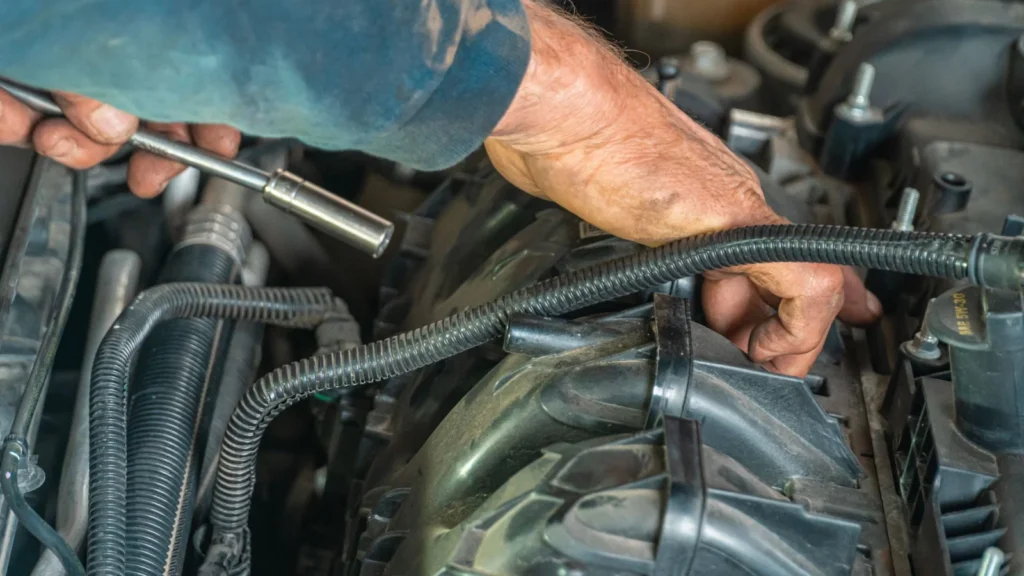
A car that jerks, stumbles or hesitates as you press the accelerator is usually struggling to get a consistent, evenly metered supply of fuel to the engine. When one or more fuel injectors aren’t delivering fuel properly, the engine fires unevenly under load, which you feel as a jerk or a momentary hesitation rather than smooth, predictable acceleration.
It’s a symptom that’s easy to notice but often gets put off because the car still drives, just not smoothly. Left alone, it tends to get more pronounced rather than settle down on its own.
Likely causes
Jerking or hesitation under acceleration has a fairly focused list of usual suspects.
- Dirty or partially blocked fuel injectors delivering an uneven fuel spray
- A failing fuel injector that’s stuck open or closed
- Worn spark plugs or ignition coils causing intermittent misfires
- A faulty throttle position sensor sending incorrect signals to the engine control unit
- Contaminated or low-quality fuel affecting how cleanly the injectors atomise it
- A vacuum leak disrupting the air-fuel mixture at the point you accelerate
Why this needs attention
Jerking under acceleration isn’t just uncomfortable, it can be genuinely unsafe. Hesitating when you’re pulling out of a junction, merging onto a dual carriageway, or overtaking is exactly the moment you need predictable power, not a stumble. There’s also a mechanical cost to ignoring it: uneven fuel delivery can lead to carbon buildup, damage to the catalytic converter, and increased strain on the engine over time.
Pay attention to whether the jerking happens at specific revs, only under load, or constantly, and whether the check engine light comes on. These details help a mechanic narrow the cause down faster.
What a mechanic checks
Diagnosing injector-related hesitation starts with a diagnostic scan to check for misfire codes and live fuel trim data, which shows whether the engine is compensating for uneven fuel delivery. A mechanic will also inspect the injectors themselves for signs of blockage or failure, check the ignition components, and rule out vacuum leaks or sensor faults that can cause similar symptoms. Getting the diagnosis right matters, because injector problems, ignition faults and sensor faults can feel almost identical from the driver’s seat.
What it typically costs to fix
A dirty throttle body or a faulty MAF sensor clean or replacement usually falls in the £60-150 range including labour. Ignition coils and spark plugs together tend to run £120-280 depending on how many cylinders are affected. A fuel pump or fuel filter is a bigger job, typically £180-400, and if the issue turns out to be a failing catalytic converter or a clogged DPF on a diesel, that climbs to £300-900. Getting a proper diagnostic scan first is what stops you paying to replace parts that were never the problem.
What happens if you leave it
A jerk under acceleration rarely fixes itself and tends to get more frequent rather than less. Left long enough, a misfire can damage the catalytic converter, which is a far more expensive part to replace than whatever caused the misfire in the first place. It also makes overtaking and joining fast roads less predictable, which is where hesitation becomes a genuine safety issue rather than just an annoyance.
What you can check yourself first
Note whether the hesitation happens at a specific point, such as pulling away from a standstill, at motorway speed, or under light throttle only, since that detail narrows down whether it’s fuel delivery, ignition, or a sensor issue. Check whether the engine management light is on and whether it’s flashing, which indicates an active misfire that shouldn’t be driven on for long.
It’s also worth noting the weather and driving conditions when the hesitation happens most, since some faults, particularly those related to sensors or connectors, show up more in damp or cold conditions. Keeping a rough note of when it happens gives your mechanic a genuinely useful head start when they come to look at the car.
Writing down the exact speed and throttle position where it happens, for example only above 40mph or only from a standing start, turns a vague complaint into something a mechanic can actually go and reproduce.
How a fuel injector actually delivers fuel
A fuel injector is a precision electromechanical valve that opens for a tiny, carefully controlled fraction of a second to spray an exact amount of atomised fuel into the engine, timed to coincide precisely with when that cylinder needs it. This process happens many times per second at higher revs, and it relies on the injector’s internal components staying clean and moving freely. Carbon deposits and fuel additives that haven’t been properly refined can build up on the injector tip over time, disrupting the fine, cone-shaped spray pattern the injector is designed to produce, and a disrupted spray pattern means fuel isn’t burning as completely or as evenly as it should, which is exactly what produces the jerk or hesitation you feel under acceleration.
Why acceleration specifically exposes this fault
At a steady cruising speed, the engine’s fuel demand is relatively constant and injectors have an easier, more consistent job to do. The moment you accelerate, fuel demand increases rapidly and the engine control unit has to command more fuel through the injectors quickly and precisely to match that demand. A partially blocked or worn injector that can just about keep up with steady, low demand often can’t respond as cleanly to that sudden increase, which is why jerking and hesitation show up specifically during acceleration rather than during steady cruising, even though the injector fault itself is present all the time.
Why fuel quality genuinely matters for injector health
Not all fuel is created equal in terms of the additives it contains, and cheaper fuel from stations with lower turnover can sometimes contain more contamination or fewer of the detergent additives that help keep injectors clean over time. This isn’t about needing to buy the most expensive premium fuel available, but using fuel from a reputable, high-turnover station and occasionally using a fuel system cleaner additive as part of routine maintenance can genuinely help keep injectors performing as designed for longer, reducing how often this kind of hesitation develops in the first place.
Distinguishing injector wear from a sensor fault
Because hesitation and jerking can also come from a faulty throttle position sensor feeding incorrect information to the engine control unit, it’s worth understanding these are diagnosed differently even though they can feel similar from behind the wheel. A sensor fault often shows a specific, repeatable pattern tied to throttle position rather than engine load, and it typically shows up clearly in live sensor data during a diagnostic scan, sometimes without needing to test drive the car at all. An injector fault is more often confirmed through fuel trim data showing the engine control unit compensating for uneven delivery, or by testing individual injectors directly for flow rate and spray pattern.
What to expect during a mobile diagnostic
A mobile diagnostic for hesitation starts with a scan for stored fault codes and a look at live fuel trim data while the engine runs, which often points toward whether the issue is fuel delivery, ignition, or a sensor before any physical component testing begins. Individual injectors can be tested for resistance and, in some cases, flow using portable diagnostic tools, and ignition components get checked alongside this, since ruling out a simple coil or plug issue before assuming a more involved injector fault saves unnecessary cost.
What you can check yourself before booking
Note the exact conditions where the hesitation happens most, a specific rev range, only under hard acceleration, or even at gentle throttle openings, since this detail genuinely narrows down the likely cause before a mechanic even arrives. Check when your spark plugs were last changed, since ruling out the cheaper ignition-related causes first is sensible before assuming the injectors themselves need attention.
Prevention through routine maintenance
Using a reputable fuel from a station with good turnover, combined with an occasional fuel system cleaner as part of routine maintenance, genuinely helps keep injectors performing cleanly for longer. Sticking to recommended spark plug and coil service intervals also reduces the chance of an ignition-related cause being mistaken for injector wear, since ruling out the ignition side first keeps any eventual injector diagnosis more reliable and focused.
Why this fault is sometimes mistaken for a transmission issue
On an automatic car particularly, a jerk during acceleration caused by a fuel delivery issue can sometimes be mistaken by drivers for a transmission problem, since both can produce a broadly similar physical sensation through the car. The key distinguishing detail is usually timing: a fuel delivery jerk tends to happen at any point during acceleration regardless of gear, while a transmission-related jerk is typically tied specifically to the moment of an actual gear change. Paying attention to whether the jerk coincides with a gear shift or happens independently of it is genuinely useful information to pass along.
Why intermittent faults are the hardest to catch
A hesitation that happens once every few days rather than consistently every time you accelerate is understandably harder to diagnose than a constant fault, since a mechanic may not happen to reproduce it during a single test drive. Keeping a simple log, noting the date, approximate speed and conditions each time it happens, builds a pattern over a week or two that is often far more useful for diagnosis than a single, unreliable snapshot.
A quick final thought: modern fuel is formulated to be broadly consistent across suppliers in the UK, so a sudden change after switching fuel stations is less likely to be the sole explanation than many drivers initially assume, though it remains worth mentioning if the timing lines up.
Why hesitation sometimes worsens in wet weather
Damp conditions can sometimes make an already marginal ignition or sensor connection more likely to misbehave, since moisture can affect resistance at a connector that is not perfectly sealed. If you have noticed the hesitation seems worse on wet days specifically, that detail is worth mentioning, since it can point a mechanic toward checking connector and wiring condition more closely alongside the injectors themselves.
Getting an accurate diagnosis the first time, rather than replacing parts speculatively, remains the most cost effective route through this particular fault, given how many different systems can produce a broadly similar symptom from behind the wheel.
Many owners describe feeling real relief once a hesitation fault is finally diagnosed and fixed, having unconsciously adjusted their driving style around the jerk for weeks or months without fully registering how much smoother normal acceleration should actually feel.
Booking a proper diagnostic scan sooner rather than later avoids the frustration of an intermittent fault becoming a familiar but unresolved annoyance that gradually gets worse without ever quite becoming urgent enough to prioritise.
Smooth, predictable acceleration is not a luxury, it is a basic expectation worth restoring properly rather than living around indefinitely.
A car that pulls away cleanly every time makes ordinary driving noticeably less stressful, particularly at busy junctions.
Restoring smooth acceleration properly is worth the short time it takes to diagnose accurately.
A short diagnostic visit is a small investment compared to the ongoing frustration of an unresolved hesitation.
SSK Mechanics carries out this diagnostic and the repair at your home or workplace across Bradford and West Yorkshire, so you get an accurate fix rather than a guess.
SSK Mechanics carries out this diagnostic and the repair at your home or workplace across Bradford and West Yorkshire, so you get an accurate fix rather than a guess.
When to book vs when it can wait
If the hesitation is mild and occasional, it’s still worth booking a check soon, since injector wear tends to progress. If it’s happening regularly, especially at higher revs or under load, or the check engine light is on, treat it as something to sort before your next longer journey.
Which? car maintenance advice highlights that ignoring intermittent engine faults like hesitation often leads to a bigger repair bill later, as the underlying issue keeps stressing other components. Once injectors are confirmed as the cause, our fuel system service covers a full Fuel Injector Replacement and Coding.
Source: Which? car maintenance advice
Frequently asked questions
Why does my car jerk only when I accelerate hard?
Under load the injectors need to deliver more fuel more precisely. If one is worn, blocked or failing, that extra demand is where the uneven delivery becomes noticeable as a jerk.
Can bad fuel cause my car to jerk under acceleration?
Yes, contaminated or poor-quality fuel can affect how cleanly the injectors spray fuel, causing hesitation, though a diagnostic is still the best way to rule out a mechanical fault.
Does a fuel injector replacement need coding afterwards?
Yes, new injectors typically need to be coded to the engine control unit so it recognises their exact flow characteristics and delivers fuel accurately.