

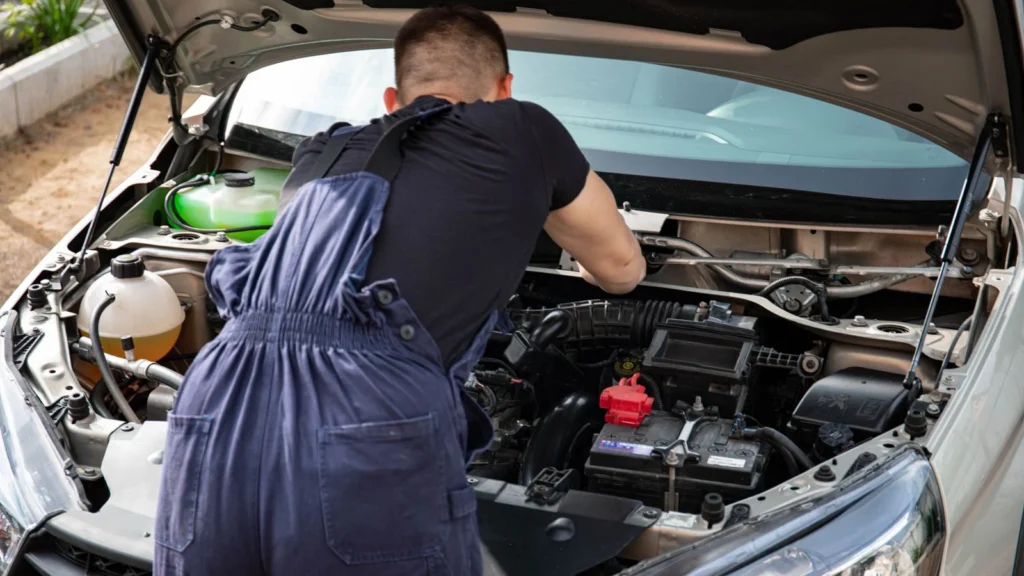
If your car will not start, begin with what it actually does when you press the start button or turn the key. A completely dead dashboard, rapid clicking, one solid click, slow cranking and normal-speed cranking are different clues. They do not all mean “flat battery”, and replacing the part most often mentioned online can leave the original fault untouched.
This guide helps UK drivers describe the symptom, make only low-risk observations and choose between a battery check, charging-system test, starter investigation or broader fault diagnosis. It cannot identify a failed component remotely. The exact vehicle, warning messages, recent work and test results still matter.
First: is the vehicle in a safe place?
If the vehicle has stopped in moving traffic or on a motorway, personal safety comes before testing. Follow the Highway Code: try to reach a place of relative safety, use hazard warning lights when the vehicle is causing an obstruction and keep people away from moving traffic. Do not attempt repairs on a motorway carriageway. If you cannot get left or leave the vehicle safely, remain belted, use the hazards and call 999.
Do not attempt a jump start where cables are damaged, the battery is leaking or distorted, there is smoke, heat, sparking or a burning smell. Keep away from orange high-voltage cables and covers on hybrids and electric vehicles. A mobile appointment also requires firm, level, legal parking with enough safe working space; an unsafe roadside location needs recovery rather than a driveway-style repair.
The five starting symptoms that change the diagnosis
1. No lights, no sound and no response
A completely dead vehicle directs attention first to the 12V supply and main connections, but it does not prove that the battery itself has failed. A discharged battery, loose or resistive terminal, earth connection, main fuse, power-distribution fault or control-system problem can remove electrical power. Some vehicles retain a few interior functions even when voltage under starting load is inadequate.
Check only what is visible without dismantling: do the interior lights, hazards, central locking or horn work; does the dashboard wake; and did anything change after recent battery, body or electrical work? Do not bridge terminals or place a tool across the battery. If the battery is beneath a seat, in the boot or behind trim, use the manufacturer’s designated starting points and handbook instructions rather than guessing.
2. Rapid clicking or a slow, laboured crank
Rapid clicking commonly occurs when the available voltage collapses as the starter is requested. Slow cranking can follow a weak or discharged battery, poor connections, cable voltage loss, high starter demand, cold conditions or mechanical resistance. Headlamps dimming heavily is a useful observation, not a verdict.
A proper battery test considers charge state and the battery’s ability to support starting load. Connection and voltage-drop tests then check whether usable power reaches the starter. Fitting a new battery without checking why the old one discharged can create a short-lived improvement followed by the same breakdown.
3. One solid click but the engine does not turn
One click may involve the starter solenoid or starter motor, but the battery and cables remain part of the same starting circuit. A relay, control authorisation, earth fault or mechanical problem can also produce a no-crank condition. Repeatedly holding the key or button can overheat cables or damage a starter that is already struggling.
Record whether the fault is intermittent, whether it changes when the car is hot, and whether a jump pack makes any difference. Those facts help separate low supply from a starter that fails only under particular conditions. Do not strike the starter or crawl under an unsupported vehicle.
4. The engine cranks normally but will not fire
Normal-speed cranking moves the investigation beyond a simple “starter versus battery” choice. The engine may lack correct fuel delivery, ignition, compression, timing or permission from the immobiliser or engine-management system. Diesel preheating, crank/cam signals and vehicle-specific control faults may also matter. A fault-code scan can preserve useful evidence, but a code is not automatically an instruction to replace the named sensor.
Note the fuel level, exact warning messages, whether the spare key behaves differently, whether the engine briefly catches, and what happened immediately before the problem. Recent refuelling, battery disconnection, repairs, heavy rain, impact or a long period unused can all provide context. Avoid repeated long cranking attempts because they can discharge the battery, overheat the starter and complicate the original evidence.
5. It starts, but the battery light remains on or it dies later
A battery-shaped warning while the engine is running is principally a charging-system warning, not proof that the battery needs replacing. The Highway Code says it may mean the battery is not charging and should be checked promptly to avoid losing power to lights and other electrical systems. Possible areas include alternator output/control, the auxiliary belt, wiring, connections and battery-management faults.
A newly fitted or freshly charged battery can temporarily hide a charging problem because the car runs from stored energy. When that energy is exhausted, electrical systems may fail and the engine may stop. If the warning appears while driving, reduce non-essential electrical loads only where safe, reach a place of relative safety and arrange assessment rather than planning to continue until the car stops.
Battery, starter and alternator: what each part actually does
The 12V battery stores electrical energy and supplies the high current needed during starting. The starter uses that energy to turn a combustion engine. Once the engine is running, the alternator and its control system supply electrical demand and replenish the battery. These functions are linked, which is why one weak connection can imitate more than one failed component.
- Battery-related evidence: slow cranking, repeat flat events, a large improvement with external electrical support or a failed health/load test.
- Starter-circuit evidence: a no-crank or single-click symptom with a proven healthy supply, acceptable cable voltage drop and a fault localised to the starter/control circuit.
- Charging-system evidence: a warning while running, measured charging/control problem, belt fault or a battery that repeatedly loses charge because replenishment is inadequate.
- Something else: normal cranking with no firing, immobiliser messages, fuel/ignition/control faults, mechanical resistance or an unwanted electrical drain while parked.
Symptoms overlap. That is why SSK’s battery and electrical service guide starts with testing rather than treating a battery, starter or alternator as an interchangeable guess.
Safe pre-checks before you book
- Photograph the complete dashboard while safely stationary, including the exact wording and colour of warnings.
- Describe the sound precisely: silence, rapid clicks, one click, slow crank, normal crank or grinding.
- Check whether hazards, interior lights, central locking and headlamps operate, without dismantling components.
- Look from a safe position for an obviously loose terminal, damaged cable or missing auxiliary belt. Do not touch a moving belt or hot engine.
- Record recent jump starts, battery replacements, charging warnings, short-journey use, long storage or electrical accessories fitted.
- Have the registration, mileage, battery invoice and relevant repair history ready.
These observations can improve the first appointment, but they are not a substitute for testing. Never open a sealed or maintenance-free battery, smoke near a battery, reverse jump-lead polarity or rely on generic jump-start instructions when the handbook specifies dedicated terminals or a different procedure.
Why a jump start is not a diagnosis
A successful jump start confirms only that additional electrical support changed the outcome. The original battery might be discharged but recoverable, internally worn, the wrong specification, poorly connected or repeatedly drained. The alternator may not be replacing the energy used, or another circuit may consume power while the vehicle is parked.
After a jump, do not assume that a short drive has fully recharged the battery. Charging time depends on battery condition, vehicle strategy, electrical demand and journey conditions. Modern smart-charging systems do not maintain one simple fixed voltage in every situation. Testing should therefore use vehicle-compatible equipment and interpretation rather than a universal voltage number copied from another car.
For the detailed decision, read Jump Start or New Battery?. If it repeatedly discharges, use Why Does My Battery Keep Going Flat? before purchasing another battery.
Stop-start, AGM, EFB and battery registration
Stop-start and energy-management systems can require EFB or AGM battery technology. VARTA’s technical guidance says an AGM-equipped vehicle should retain AGM technology and that start-stop vehicles need a battery compatible with their battery-management system. Some BMW, Mercedes and Volkswagen Group vehicles require a registration procedure after replacement so the energy-management system knows a new battery has been fitted.
That does not mean every car uses the same registration method, or that an “upgrade” is automatically correct. The original specification, vehicle equipment, physical size, terminal layout, capacity and manufacturer procedure must be checked against the exact registration or VIN. Read the broader car battery replacement and technology guide before comparing quotes that may include different batteries or coding work.
Hybrid and electric vehicles can still have a flat 12V battery
An electric or hybrid vehicle normally has a conventional low-voltage system as well as its traction battery. The 12V supply wakes control units and allows the high-voltage contactors to operate, so a vehicle with charge displayed in the traction battery can still appear completely dead. That does not authorise an owner to access either battery system.
Use only manufacturer-designated low-voltage assistance points and handbook procedures. Never probe, disconnect or remove orange high-voltage components. Damaged high-voltage cables, battery impact, hissing, unusual heat, smoke or a solvent-like smell require people to move away and specialist or emergency help as appropriate.
What professional testing should separate
A structured non-start investigation should answer a sequence of questions instead of producing a parts list. Is the battery sufficiently charged to test? Can it support starting load? Are the terminals, earths and positive cables carrying current without excessive voltage loss? Is the starter being commanded and how does it respond? Once running, does the charging system behave as the vehicle strategy expects? Are fault codes, immobiliser status or live data relevant to a normal-crank non-start?
If the battery becomes flat only after parking, the next stage may be an unwanted-current investigation. That requires allowing modules to shut down correctly and measuring over time; pulling fuses at random can wake modules, erase information or introduce new faults. The result should identify evidence for a repair, not merely show that a code scanner was connected.
Choose the right SSK booking route
- Car Won’t Start Inspection: best when the failed component is not confirmed.
- Battery and Charging System Check: suitable for slow cranking, repeated discharge or checking battery and charging performance separately.
- Battery Replacement: appropriate when the battery requirement is known, while exact technology and registration still need vehicle confirmation.
- Alternator Replacement: choose only when testing has confirmed the charging fault or you can provide a reliable prior diagnosis.
- Starter Motor Replacement: choose when the starter has been confirmed rather than inferred from one click.
- Find The Fault: suitable for normal cranking, warning messages or symptoms that extend beyond the starting circuit.
SSK provides mobile starting, charging and diagnostic support around Bradford and nearby parts of West Yorkshire, subject to the full postcode, vehicle, job and safe access. Customers in Shipley, Bingley, Pudsey, Cleckheaton and other listed areas should enter the complete service postcode rather than assuming a town name alone confirms coverage.
Related starting and charging guides
- Car won’t start but makes a clicking sound
- Car cranks but will not start
- Battery warning light: what it means while driving
- Alternator diagnosis and replacement cost
- Starter motor diagnosis and replacement cost
Sources and accuracy
Roadside safety follows the Highway Code breakdown rules. Charge-warning guidance comes from the Highway Code vehicle-maintenance annex. Battery-technology statements are supported by VARTA’s start-stop replacement guidance; starting and charging systems are separate test areas in Bosch’s starter and alternator technical information. The handbook and manufacturer information for the exact vehicle take priority over generic web advice.
Information reviewed 14 August 2026. If the car is safely parked and you are ready for a tested answer, book a car-won’t-start inspection online with the registration, postcode and exact symptom.
Frequently asked questions
Why won't my car start even after a jump start?
A jump can only provide temporary electrical assistance. A poor connection, starter-circuit fault, immobiliser issue, lack of fuel or spark, mechanical problem or charging fault can still prevent starting. The symptom and test results should decide the next step.
Does one click always mean the starter motor has failed?
No. A single click can involve the starter or solenoid, but low battery voltage, cable resistance, an earth fault, relay/control issue or mechanical resistance can create a similar result.
Can an alternator stop a car from starting?
The alternator normally replenishes the 12V battery while the engine runs. If it fails, the battery can discharge until there is not enough energy for the next start. The stored battery condition and charging system should therefore be tested separately.
Should I replace the battery because the car starts with a jump?
Not automatically. The jump shows that extra electrical supply changed the symptom, but it does not prove whether the battery is worn, merely discharged, poorly connected or being drained because the charging system or another circuit is faulty.
Can SSK check a non-start at my home or workplace?
Many non-start investigations are suitable for a safe home or workplace location. The vehicle must be legally parked on firm, level ground with safe working space. Live-traffic, motorway, high-voltage or heavy mechanical situations need an appropriate recovery or workshop route.